
Search Antique Clocks
Showing 6,361–6,380
of 8,820 clocks
by unsigned
-
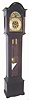 German, B+D Trademark, 2-wt gong striking tall clock with rolling moon brass dial, seconds hand below 12 and calendar above 6, in a dark mahogany case with glazed front door, and heavy lead filled pendulum. Dial with raised gilt Arabic numerals.
 -
 Reproduction dwarf tall case, in the style of Joshua Wilder, Hingham, Mass and with his name and town applied to the dial, C.1980, cherry case with turned columns flanking the dial.
 -
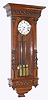 Austrian, 3-wt Grand Sonnerie, full quarter striking wall clock, in a walnut case, C.1875
 -
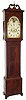 Scottish, unsigned, C.1840, arched dial tall clock with rolling moon, 8-day, 2-wt, bell strike, in a mahogany and mahogany veneer case with cross banded trim.
 -
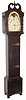 American tall clock, unsigned, 8-day with rolling moon, the last repair label from 1883, Philadelphia. Mov't with well shaped plates along the top and cut out at bottom to conserve brass. The informal country case of mixed woods retains large cast door hinges and a deep broken arch. C.1825.
 -
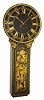 English, Time and bell strike TAVERN CLOCK, 26" dial with gilt Roman numerals, in a Chinoiserie case, the with raised figures in period dress, amongst gardens and temples, C.1800.
 -
![A reproduction tiger maple tall clock with scroll top and carved rosettes, full columns flanking the hood door, and quarter columns flanking the tombstone door with carved fan at top. The base or plinth of the case has matching quarter columns and well proportioned French feet. With a period [C.1830] American 8-day 2-wt time and strike movement, having a painted iron dial with Roman numerals and eagle in the arch.](/images/robertoschmitt19/ts_2112_a.jpg) A reproduction tiger maple tall clock with scroll top and carved rosettes, full columns flanking the hood door, and quarter columns flanking the tombstone door with carved fan at top. The base or plinth of the case has matching quarter columns and well proportioned French feet. With a period [C.1830] American 8-day 2-wt time and strike movement, having a painted iron dial with Roman numerals and eagle in the arch.
A reproduction tiger maple tall clock with scroll top and carved rosettes, full columns flanking the hood door, and quarter columns flanking the tombstone door with carved fan at top. The base or plinth of the case has matching quarter columns and well proportioned French feet. With a period [C.1830] American 8-day 2-wt time and strike movement, having a painted iron dial with Roman numerals and eagle in the arch. -
 Unsigned Pennsylvania Tall clock, probably Montgomery County, 8-day, painted rolling moon dial, in a cherry case with full turned columns flanking the dial, and turned spindle style quarter columns flanking the center of the case, and with 4 spindle feet. 2-wt. c.1825.
 -
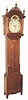 New Hampshire, 8-day, 2-wt tall clock, C.1820, probably by either James C. Cole or Benj. Morrill of Boscawen, in a heavy birch case with reeded side columns w/ brass capitals, and a hood with full turned columns flanking the dial, and surmounted by pierced frets.
 -
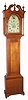 New Hampshire, 8-Day Painted Dial tall clock (unsigned dial), C.1820, in a birch case with maple coloring, and with a scroll or broken arch top.
 -
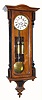 Austrian, Vienna Regulator, 2-weight wall clock, gong striking, in a simple transitional style walnut case, less top trim, C.1865
 -
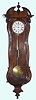 Austrian, "Vienna Regulator" one-wt timepiece, in a serpentine wall case, C.1860.
 -
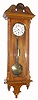 Austrian, smaller 1-wt time only Vienna Regulator with 4.5" dial, in a light walnut case, the movement showing "K. Bert, Wien" on the fine porcelain dial, 8-day, C.1880.
 -
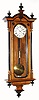 Austrian, 30-Day Vienna Regulator in a nice transitional case with smooth side columns, with ebonized accents. Has a good movement with Harrison's ratchet maintaining power. Remember to wind to the left.
 -
![Austrian, C.1860, 2-Wt DWARF "Vienna Regulator" in a light walnut carved case with floral accents and with "built-in" top. Note this is a short case with full size [7"] dial.](/images/robertoschmitt19/ts_2653_a.jpg) Austrian, C.1860, 2-Wt DWARF "Vienna Regulator" in a light walnut carved case with floral accents and with "built-in" top. Note this is a short case with full size [7"] dial.
Austrian, C.1860, 2-Wt DWARF "Vienna Regulator" in a light walnut carved case with floral accents and with "built-in" top. Note this is a short case with full size [7"] dial. -
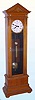 Austrian or So. German, a public building tall clock with auxiliary drive through the top for driving a large set of remote hands, probably a large gallery slave in a bank or department store. With a heavy cast iron plate movement, skeleton in form, similar to a street clock, and with a heavy meter pendulum. The mov't also with maintaining power and Graham's style dead beat escapement with adjustable pallets, C.1900
 -
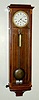 A repro miniature Vienna timepiece in the early Biedermeier style, the case of crotch mahogany with holly banding around the edges and additional inlay. The weight driven movement is a well made copy of a mini original. C.2000,
 -
![Austrian, C.1850, 45-Day movement [5 wheel-winds left], in a C.1980 {modern} laterndluhr case made to period proportions.](/images/robertoschmitt19/ts_2367_a.jpg) Austrian, C.1850, 45-Day movement [5 wheel-winds left], in a C.1980 {modern} laterndluhr case made to period proportions.
Austrian, C.1850, 45-Day movement [5 wheel-winds left], in a C.1980 {modern} laterndluhr case made to period proportions. -
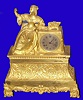 French, ormolu figural clock, A Lady at her Dressing Table, with an open box of jewels, 8-day time and bell strike, with silk thread movement, C.1840. This clock is larger than average.
 -
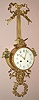 French, Gilt brass cartel clock, Louis XVI style, C.1870 in the style of a century earlier, 8-day bell strike.