Search Antique Clocks
Showing 4,541–4,560
of 6,176 clocks
by K
-
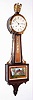 Chelsea Clock Co., Boston, Mass., 8 day, time/house strike 3/4 size banjo or patent time piece. Serial no. 744708, c1971.
 -
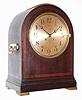 Chelsea Clock Co., Boston, Mass., "Doric", 8 day, time and strike, mahogany case mantel clock retailed by Tiffany and Co., Serial No. 35255, c1908.
 -
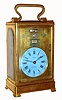 Austro-Hungarian, Kralik Sam, Buda - Pestini, rare perpetual calendar and grand sonnerie carriage clock, with "6-rubis cilindre" platform escapement, indications in German, c1850
 -
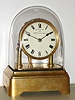 Eureka Clock Co, London, "1000 Day Electric Clock, electro mechanical mantel clock, battery powered, time only with large cut bimetallic balance and blued steel balance spring, Roman numeral white enamel dial with heavy gilt bezel, blued steel hands, movement with spotted back plate, supported on gilt columns, with finial style nuts securing the movement, all on a gilt brass base, and covered with a glass dome, s#14614 c1910
 -
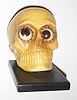 Oswald Uhrenfabrik, Germany, "Skull" rotating eye time piece, 30 hour, time only, spring driven movement in a composition case with yellow skull and brown eyes, c1930
 -
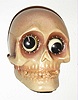 Oswald Uhrenfabrik, Germany, "Skull" rotating eye time piece, 30 hour, time only, spring driven movement in a composition case with grey skull and brown eyes, c1930
 -
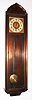 Kienzle, Germany, walnut year-duration fusee hanging time piece, c1925
 -
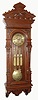 German, Gustav Becker, 3-weight, Grand Sonnerie "Vienna Regulator", with a fancy multi rod "faux-grid" pendulum, the dial center and pendulum with matched scroll engraving; weights with a different pattern, in a case of carved walnut and veneers, c1885
 -
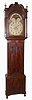 English, "Thomas Barry, Bolton", 8 day, time and strike, tall clock in a mahogany case, c1820.
 -
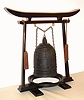 A rare and early Japanese bell clock (Tsurigane Dokei) within a finely cast bronze bell with Japanese characters and double headed dragon form handle; having a posted, iron, double spring driven, striking movement with crown wheel escapement and time regulated by a large circular balance with moveable double weights, originally for adjusting the temporal hours every day before each sunrise and sunset with the change of each Japanese season. The brass dial with single, fixed hand has traditional Japanese numerals 9 through 4 with applied silvered butterflies to the original surrounding dial plate. The rotating dial with adjustable "hour" and "half hour" markers is a common 19th Century upgrade to many very early Japanese clocks that have a single foliot or balance, since changing the weights and hence the rate before sunrise and sunset each day was extremely unhandy. This is verified by J. Drummond Robertson in The Evolution of Clockwork , page 226 saying "we find some of the old clocks "converted" to the new style of motion work. The old fixed hour circle with its revolving centre was removed and the new revolving circle and its fixed hand with adjustable "hour" plates was substituted." This is the case in each of the only other examples of Japanese Bell Clocks of which we are aware: see Japanese Clocks by N.H.N. Mody, plate 113, fig.1 for an almost identical example to the clock being offered. This dial conversion is also apparent in the Bronze Bell Clock sold at Sotheby's Masterpieces From the Time Museum Sale, Part Two, 19 June 2002, lot 126. An inscription on the bell reads Fukushima ya Katsutaro 1689, who may be the maker of either the clock or the bell. Most Japanese spring driven clocks have a fusee to the time train and a going barrel to the strike train. This movement is anomalous, in that is has two going barrels. It may be that the Japanese had not developed a method of turning a fusee at this early date, c1690
 -
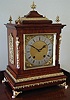 Lenzkirch ting tang striking bracket clock, circa 1895
 -
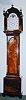 A very good George III 8 day mahogany long case clock, W. Hooker, Lewes, working 1803-32
 -
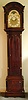 A very fine George III mahogany 8 day long case clock, James Clark, London, Circa 1785
 -
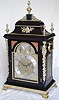 A very fine George III ebonised and ormolo mounted quarter chiming bracket clock, Geo. Kershaw, London
 -
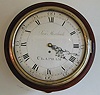 A good George III mahogany dial clock with salt box case. Samuel Mortlock, Clapham
 -
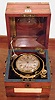 A good 2 day mahogany brass bound box chronometer; Parkinson & Frodsham, Circa 1840 retailed by Urban Jurgensen No 41. Size: 3" dial. 6" box
 -
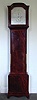 A fine mahogany long case regulator, William Jackson, London, Circa 1820
 -
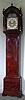 A fine George III 8 day mahogany long case clock, Edward Clarke, London, Circa 1775
 -
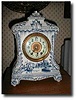 Waterbury Delft Style Porcelain Shelf Clock, circa 1905
 -
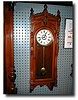 The Kroeber Clock Co. Regulator Wall Clock, Model No. 45, circa 1895