Search Antique Clocks
Showing 4,901–4,920
of 5,197 clocks
from France
-
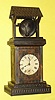 C.1898, Wm. L. Gilbert, BELFRY ALARM, Rolling bell alarm clock, one day timepiece.
 -
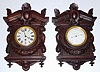 C.1875, French, Roblin and Fils, Clock and Barometer Cartel Set, in carved oak, the clock an 8-day timepiece, and the barometer an Aneroid model, a pair of lions adorn the sides of each.
 -
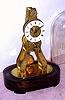 C.1851, French, Pierret, Mini Skeleton timepiece with engraved front plate and porcelain dial, base marked Ms.Honorables, Exp. Paris, Londres, and the back plate with the initial "P".
 -
 C.1895, French, for Smith and Sons, London, THE EMPIRE CLOCK, small 8-day globe / world time clock, serial 322. A brass ring around the equator shows 24 hours, and a pointer indicates local time for your "home" region. Wind, set and regulate from base. English possessions are shown in light orange, others in ivory color.
 -
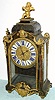 C.1750, French, Massoii, Paris, Boulle clock with tortoise shell and brass inlay with unique single spring time, qtr strike and repeat movement, with 3 bells atop case.
 -
![C.1913 [dated], French, Samuel Marti for Bailey Banks and Biddle, Philadelphia PA: Brass crystal regulator with 8-day time and strike movement and 2-glass vial pendulum.](/images/robertoschmitt16/t384.jpg) C.1913 [dated], French, Samuel Marti for Bailey Banks and Biddle, Philadelphia PA: Brass crystal regulator with 8-day time and strike movement and 2-glass vial pendulum.
C.1913 [dated], French, Samuel Marti for Bailey Banks and Biddle, Philadelphia PA: Brass crystal regulator with 8-day time and strike movement and 2-glass vial pendulum. -
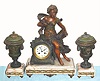 C.1900, French, Samuel Marti, Paris, 3-Piece Mantle Garniture, L' Histoire, a young girl with pen in her right hand, with her diary open, roses in her lap. Urns and figure of patinated white metal, with ormolu acanthus garlands spread across the marble bases.
 -
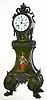 C.1890, French, for J. E. Caldwell, Philadelphia, mini tall case of wood, decorated in the style of Vernis Martin, and profusely accented with bronze trimmings at all corners, and with 4 hairy paw feet. The front of the dark green case has a painting of a young lady with large hat, and the sides are painted with flowers.
 -
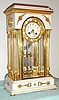 C.1895, France, S. Marti, White Marble and Ormolu 4-glass "Crystal Regulator", with the 12 Zodiac signs surrounding the porcelain dial, cast lions on each side of the case, and with 2-vial compensating pendulum intact.
 -
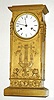 C.1825, French, Lesieur, Gilt Bronze Empire mantel clock, 8-day, bell strike, the case with musical lyre on the front and wreaths to the sides, with a full length torch at each corner.
 -
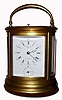 C.1890, French, Leroy and Fils, 13 and 15 Palais Royal, Paris, Brass Cased GRAND SONNERIE carriage clock, in a gilt oval case and with original lever platform intact. Also with alarm and repeat. Serial No. 9876. Interestingly this clock was likely made by Drocourt, as it also bears a separate serial No. 10676, which fits their series, and the little oval with their trademark has been flattened with a punch.
 -
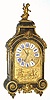 C.1775, Le Roy, Paris, BOULLE clock, crown verge mov't, silk susp, remote bell.
 -
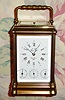 C.1980, /modern/ French, L'Epee, Gorge Cased calendar carriage clock with time, strike and repeat, subsidiary dials at the bottom of the main dial for day and date.
 -
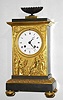 C.1840, French, Gaston Jolly, Paris, Bronze and Ormolu, Empire style mantel clock, 8-day bell strike with silk thread suspension, commemorative to Achille and Ulysse, shields in top corners with their names.
 -
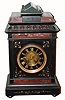 C.1895, French, Japy Freres and Cie, Black slate with red/gold accents mantel clock, 8-day gong striking.
 -
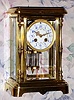 C.1900, French, Japy Freres, Crystal Regulator, in a brass case with full standing columns at the front corners; a cream colored dial with polychrome floral decorations and a 2-vial compensating pendulum.
 -
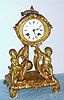 C.1850, French, Japy Farres, Paris: French Ormolu miniature shelf clock with cherubs and 8-day time and strike movement, the dial set into an oval easel.
 -
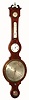 C.1860, English, Banjo Barometer with clock, with mercury tube intact, retailed by C. A. Canti, 4 Crofts St., Hatton Gardens (London).
 -
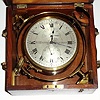 C.1810, James Hatton, London, 8-Day Marine Chronometer, serial No. 444, double frame movement with reverse fusee, Harrison's ratchet and Earnshaw type spring detent escapement, a large seconds dial with Arabic 10 second figures, and with up-down indication to 7+ days.
 -
![C.1885, French, Guilmet, HUNTSMAN, mystery clock, the patent crank and stirrup movement contained in the base flanked by two bronze dogs heads, the statue of a huntsman with rifle [on his back] and dog at his side, and the pendulum a dead pheasant. The pendulum swings with no apparent impulse from the movement, however the entire statue swivels slightly on its pivoted base to lock and unlock the escapement.](/images/robertoschmitt16/t205.jpg) C.1885, French, Guilmet, HUNTSMAN, mystery clock, the patent crank and stirrup movement contained in the base flanked by two bronze dogs heads, the statue of a huntsman with rifle [on his back] and dog at his side, and the pendulum a dead pheasant. The pendulum swings with no apparent impulse from the movement, however the entire statue swivels slightly on its pivoted base to lock and unlock the escapement.
C.1885, French, Guilmet, HUNTSMAN, mystery clock, the patent crank and stirrup movement contained in the base flanked by two bronze dogs heads, the statue of a huntsman with rifle [on his back] and dog at his side, and the pendulum a dead pheasant. The pendulum swings with no apparent impulse from the movement, however the entire statue swivels slightly on its pivoted base to lock and unlock the escapement.