
Search Antique Clocks
Showing 5,661–5,680
of 13,386 clocks
type Shelf or Mantel
-
 C.1880, French, Farret a' Paris, Bronze and white marble MYSTERY clock, the movement with a steel arm over the verge, near the top case panel, which is moved from side to side by a strong magnet in the bottom of the pendulum, which attraction for the steel pulls the pendulum toward the center and results in a 'scape at the same time. A small brass counter weight brings the verge back to center and gets it ready for the next impulse from the other direction. The bronze figure signed Ferrand.
 -
 C.1900, English, Albert Barker, 5 New Bond St, London, Dwarf Tall Clock, mahogany, with profuse inlay, and on a shelf from the same period, with some Nouveau influence. The movement signed on the rear plate, "Made in France, especially for Albert Barker, London", and the dial signed as in the headline.
 -
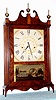 C.1820, Seth Thomas, Off-Center Pillar and Scroll, 1-day, 2-wt, strap wood movement, mahogany case.
 -
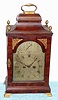 C.1790, English, George III Mahogany bracket clock with ormolu mounts, 2-fusee, bell strike, with engraved back plate, converted from crown/verge to anchor escapement.
 -
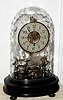 C.1920, French, Bulle. Battery clock with 24 hour dial, under cut crystal dome with floral pattern.
 -
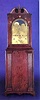 C.1785, (Nathan) Adams, Danvers, Massachusetts, rare shelf clock, brass dial, with rolling moon and seconds bit, with restorations.
 -
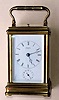 C.1900, Brass Cased Carriage Clock, Drocourt, for Vqr. Fleury, 23 Rue de la Paix, Paris, time, bell strike, repeat and alarm, in a Cannelee case.
 -
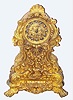 C.1830, French, Guyerdet Aine, Paris, rococo style gilt bronze figural clock, the case profusely decorated with shells and fruit and with lions paw feet, the well made silk thread susp movement signed by the maker, struck over the Pons-1827 award medallion.
 -
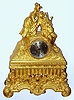 C.1830, French, Gilt Bronze figural clock, two lovers, a male playing the bag pipes, and the girl with her hands over his eyes as if asking him to guess who it is.
 -
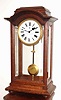 C.1900, Josef Neudhart, Graben 21, Wein I, unusual mantel regulator, the well made movement upside down with the Brocot style verge at the bottom of the movement, and the pendulum similarly suspended behind the 6 (likely that Neudhart attended clock makers school in France).
 -
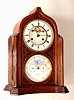 C.1890, French, Brocot and Delettrez, for the English Market, double dial perpetual calendar in an oak and veneer case of Gothic style, with open escapement on the porcelain dial.
 -
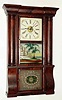 C.1850, Forestville Mfg. Co., (J. C. Brown label), 8-day time/strike column and cornice shelf clock.
 -
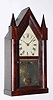 C.1848, Brewster and Ingrahams, 8-day Steeple, with brass springs, 8-day gong striking.
 -
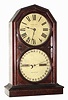 C.1886, Seth Thomas Clock Co., "PARLOR CALENDAR No. 5", in walnut, perpetual double dial calendar, 8-day time with strike.
 -
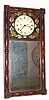 C. 1830, Unsigned Mirror Clock, the clock has an 8-day time and strike weight-driven movement.
 -
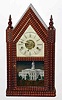 C.1848, J. C. Brown, Forestville Mfg, Bristol, Conn, miniature ripple steeple clock, its original movement signed J. C. Brown, 1-day, T/S/Alarm.
 -
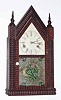 C. 1848, J. C. Brown, Forestville Manufacturing Co., Bristol, Conn., miniature ripple steeple clock with its original signed 30-hr time and strike movement.
 -
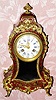 C.1890, French, Henry Marc, Paris, Mini Boulle clock in the style of a century earlier, with a platform lever escapement.
 -
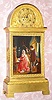 C.1840, French, Fine Ormolu Mantel Clock, with a hand painted porcelain plaque of two early-19C musicians in court dress, a lady playing the piano or harpsichord, and a gentleman playing a mandolin, displayed in a classic Empire case with cast decorations, a harp on each side, and the silk thread movement with the markings UE-188 and with matched number pendulum.
 -
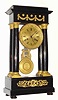 C.1860, French, "F-C", 4-Column Empire style mantel clock, in an ebonized case with gilt bronze mounts, (swags and floral elements) gilt dial and pendulum, and with original glass dome and base.