Search Antique Clocks
Showing 61–80
of 294 clocks
type Skeleton
-
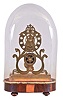 England, skeleton clock, the eight day fusee timepiece with nicely designed and executed scroll frames, the pattern similar to those used by Condliff for their great wheel clocks, Roman numeral brass dial with scalloped edge and oval piercing, brass hands and pendulum, mounted to a gilt plinth, and fixed to a velvet lined, rosewood veneered base with turned feet and dome
 -
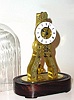 C.1851, French Skeleton Timepiece, with engraved front plate, on a wooden base, silk thread suspension.
 -
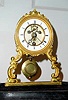 C.1875, French Skeleton Timepiece, with a cast frame, open escapement and original glass dome.
 -
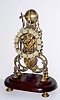 C.1900, English, Skeleton Clock, chain fusee with passing strike on the hour.
 -
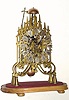 C.1975, Spanish, Marton and Gain, 2-fusee, full striking skeleton clock, less dome.
 -
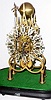 C.1950, Classic Clocks, England, 8-day fusee passing strike skeleton timepiece.
 -
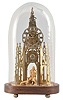 England, Sir Walter Scott Memorial brass skeleton clock, unsigned, the brass frame of cathedral form with pierced and silvered roman numeral chapter ring, chain fusee eight day, five train movement with maintaining power and lever escapement with regulation sector and hand all on a walnut base with gilt figures of Sir Walter Scott and his dog, beneath a glass dome.
 -
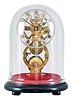 England, skeleton timepiece with center seconds and platform escapement, pierced, triple Venn diagram frame, Roman numeral silvered dial, blued steel spade and poker hands, 8 day fusee movement with 7 jewel lever platform and brass balance, all on a turned, ebonized base with glass dome
 -
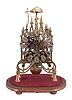 Martin and Gain, Madrid, Spain, 2-fusee skeleton clock, the multi spired Gothic frame of brass is well fretted and polished. This firm launched in Spain to try to meet the resurging interest in skeleton clocks and a general shortage in old merchandise in the 1970's Fusees are with cable rather than chain. Wheels are simple 4-spoke design. Strikes the hours and halves on a central bell.
 -
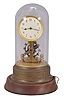 Germany, Eureka style, battery powered, electro-magnetic "skeleton" timepiece mounted on brass base with a large exposed rotating balance with dome.
 -
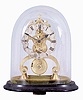 England, single fusee skeleton clock, in a well finished scroll frame, and with scalloped dial of silvered brass, nice small size, height of frame only approx. 8"
 -
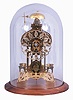 England, signed Smith, Clerkenwell, c1890 chain fusee pub movement, now in a modern skeletonized frame representing Brighton Pavilion, the frame appearing to have been cut on an EDM wire machine, and then polished by hand. The silvered dial is nicely fretted and the Roman Numerals are sharply engraved and black filled. The frame surmounted by a bell that is struck once on the passing of each hour. Covered by a round glass dome and mounted on a turned walnut base.
 -
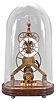 Chinese, reproduction skeleton clock, brass framed chain fusee movement with large wheels, recoil escapement, Roman numeral white enamel dial, pierced steel hands, on a wooden base with brass feet, and under a glass dome
 -
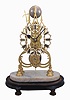 England, 3 spire Gothic frame, single chain fusee brass skeleton clock, with eight day, passing hour single bell strike, fretted roman numeral dial, all on a marble stand and wooden pedestal, lacking a dome.
 -
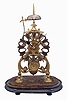 England, late 19th Century, passing strike skeleton clock, in a fretted brass scroll frame, no dome.
 -
![England, 3 spire Gothic frame, single fusee skeleton clock, with a silvered fretted dial, passing strike [single bell on the hour], no dome, mounted to a rectangular wooden base.](/images/robertoschmitt34/t17715_a.jpg) England, 3 spire Gothic frame, single fusee skeleton clock, with a silvered fretted dial, passing strike [single bell on the hour], no dome, mounted to a rectangular wooden base.
England, 3 spire Gothic frame, single fusee skeleton clock, with a silvered fretted dial, passing strike [single bell on the hour], no dome, mounted to a rectangular wooden base. -
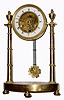 C.1820, French, Empire Period Mantel regulator, meant for display under a dome.
 -
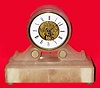 C.1890, French, Japy Freres, Marble mantel timepiece with skeletonized movement,
 -
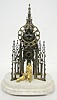 Antique Sir Walter Scott Fusee Skeleton Clock
 -
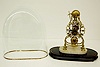 Antique Fusee Bell Striking Skeleton Clock