Search Antique Clocks
Showing 1–20
of 28 clocks
by Willard, Simon
-
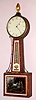 Banjo attributed to Simon Willard 8 day weight driven time only movement with Willard's distinct T-bridge suspension and fillister retaining screws in mahogany case with cross banded veneer accents and side arms, c1815
 -
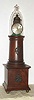 Reproduction Simon Willard lighthouse clock, C. 1960, weight driven, 8-day, passing strike, in a square based mantel case with glass bell jar over movement.
 -
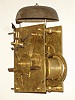 English long case 8 day time and strike movement only, Simon Willard signature (?), c1785
 -
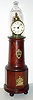 Hugh Witham, Owosso, Michigan, "Willard Lighthouse" reproduction clock, 8 day, time only, weight driven movement by John Gass, Holt, Mich. (stamped on movement) in mahogany veneer case with porcelain dial made in London, England signed "SIMON WILLARD ROXBURY" with blown gloss dome manufactured by the London School of Glass Blowing, c1979 s#3
 -
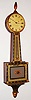 Simon Willard and Son, No. 4365, 8 day, stenciled banjo or patent timepiece, c1825.
 -
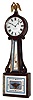 Banjo clock, Massachusetts, 8 day mahogany weight driven wall hanging timepiece with T bridge suspension, dial signed "Simon Willard, Boston", first half 19th Century..
 -
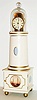 Simon Willard lighthouse bridal clock reproduction by Jeff Petrick of Prior Lake, Minnesota, 8 day, time only, weight driven movement in a painted wood case with glass dome and painted metal dial, circa 21st century
 -
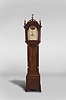 Simon Willard, Roxbury, Mass., tall clock, 8 day, time and strike, weight driven movement in typical Roxbury style mahogany case with three brass finials including center eagle finial, fretted crest, stop fluted full columns with brass capitals flanking hood and trunk doors resting on ogee bracket base. The painted metal 12-in dial by Wilson of Birmingham as found on many Willard clocks of this period is signed "Simon Willard" in script has seconds bit, calendar and scene of woman dancing in arch.
 -
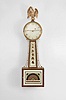 Attributed to Simon Willard, Boston, Mass., 8 day, weight brass movement patent or banjo wall timepiece.
 -
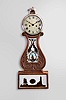 Lyre banjo, period elements, time, strike and alarm,
 -
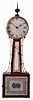 Boston 8 days, weight driven brass movement patent or banjo timepiece, c1825. Possible Simon Willard banjo as it is early with a head that is a uniform 1/2 inch thickness and has a very thin backboard. The movement has T-bridge suspension, through bolts to secure the movement. There are holes in the keystone for a crossbar. The throat frame is rabbeted on the back side and recessed into the sides of the case and anchored to the case with four screws. The door is latched to the case with an L-turn.
 -
 The Henry Ford Museum, Dearborn, Michigan reproduction Simon Willard, Boston, Mass., tall case clock, 8 day, time, strike and triple chime, weight driven movement in a mahogany Roxbury style case with three brass finials, fretwork top, fluted full columns on hood with brass terminals, string inlay, fluted corner columns on trunk with brass terminals, ogee feet and moon phase dial
 -
 The Henry Ford Museum, Dearborn, Michigan reproduction Simon Willard, Boston, Mass., tall case clock, 8 day, time, strike and triple chime, weight driven movement in a mahogany Roxbury style case with three brass finials, fretwork top, fluted full columns on hood with brass terminals, string inlay, fluted corner columns on trunk with brass terminals, ogee feet and moon phase dial
 -
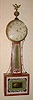 C.1815, Attributed to Simon Willard, Boston banjo, 1-weight, 8-day, with step train, T-bridge movement held in place with original fillister screws.
 -
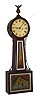 Simon Willard & Son, Boston, Mass., banjo wall clock, 8 day, time, bell strike and alarm, two weight driven movement in a mahogany case with reverse painted throat and lower tablets and painted metal dial, c1828
 -
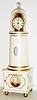 Simon Willard lighthouse bridal clock reproduction by the Petrick Clock Company of Port St. Lucie Florida, 8 day, time only, weight driven movement with a t-bridge, anchor recoil escapement and polished solid brass plates. The movement is mounted in a hand turned solid hardwood painted case, with hand blown glass dome and painted roman numeral dial, c2000
 -
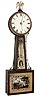 Simon Willard, Boston, Mass. attribution, 8 days, weight brass movement Patent or banjo timepiece, c1810 The cross piece on the keystone was used by William Cummens and Elnathan Taber.
 -
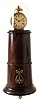 Light house clock case in the manner of Simon Willard, turned mahogany and mahogany veneer on brass ball feet, the front with applied gilt ornament, white painted Roman numeral dial with gilt bezel, mounted to a wooden block, with glass dome, 20th century
 -
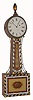 Massachusetts weight banjo, with the later applied name of Simon Willard and Son, the case with later applied gold-leaf decorations in leaf pattern, mid 19th century style, C.1840.
 -
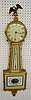 S. Willard Patent Weight Driven Banjo Clock