Search Antique Clocks
Showing 1–20
of 141 clocks
from Japan
-
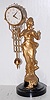 Lady Figural Swinging Clock, Linden
 -
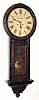 C.1910, Japan, Seikosha, HOTEL REGULATOR , large wall clock, time and strike, with lyre pendulum.
 -
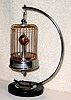 C.1947, Occupied Japan, 30-hour birdcage with rotating globe (annular dial), novelty timepiece with original marble and chrome base.
 -
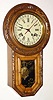 C.1910, Japan, Mini Round Drop school clock with carved bezel and calendar, 8-day with strike.
 -
 C.1987, Japan, Bisque figure of WHISTLING WILLIE, who whistles "3 O'Clock in the Morning", while turning his head from side to side, small quarts timepiece movement in street clock.
 -
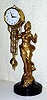 C.1970, Japan, Fuji Clock Co, DIANA SWING clock, 8-day mysterious timepiece.
 -
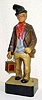 C.1955, Japan, plastic copy of a German Whistler , MAN WITH LANTERN IN HAND, whistling a lively tune, powered by an electric motor and 2 "D" cells in the base, on-off switch on right side of base.
 -
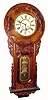 C.2000, Asian Repro of the Japanese ÓHOTELÒ model wall clock.
 -
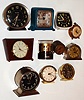 Clocks- (11) alarm clocks; (6) Westclox, an unusual Elgin annular, a Lux, a New Haven and a Linden
 -
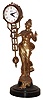 Linden, Japan, small 8 day small mystery swinger, c1970
 -
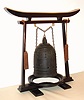 A rare and early Japanese bell clock (Tsurigane Dokei) within a finely cast bronze bell with Japanese characters and double headed dragon form handle; having a posted, iron, double spring driven, striking movement with crown wheel escapement and time regulated by a large circular balance with moveable double weights, originally for adjusting the temporal hours every day before each sunrise and sunset with the change of each Japanese season. The brass dial with single, fixed hand has traditional Japanese numerals 9 through 4 with applied silvered butterflies to the original surrounding dial plate. The rotating dial with adjustable "hour" and "half hour" markers is a common 19th Century upgrade to many very early Japanese clocks that have a single foliot or balance, since changing the weights and hence the rate before sunrise and sunset each day was extremely unhandy. This is verified by J. Drummond Robertson in The Evolution of Clockwork , page 226 saying "we find some of the old clocks "converted" to the new style of motion work. The old fixed hour circle with its revolving centre was removed and the new revolving circle and its fixed hand with adjustable "hour" plates was substituted." This is the case in each of the only other examples of Japanese Bell Clocks of which we are aware: see Japanese Clocks by N.H.N. Mody, plate 113, fig.1 for an almost identical example to the clock being offered. This dial conversion is also apparent in the Bronze Bell Clock sold at Sotheby's Masterpieces From the Time Museum Sale, Part Two, 19 June 2002, lot 126. An inscription on the bell reads Fukushima ya Katsutaro 1689, who may be the maker of either the clock or the bell. Most Japanese spring driven clocks have a fusee to the time train and a going barrel to the strike train. This movement is anomalous, in that is has two going barrels. It may be that the Japanese had not developed a method of turning a fusee at this early date, C.1690
 -
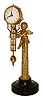 Fuji, Japan, swinging timepiece figure of cupid seated atop a fluted column and supporting the clock in his right hand, the figure with gold finish and mounted to a black painted metal base, polished brass clock case, Arabic numeral metal dial signed "Fuji", polished brass hands, 8 day timepiece movement, c1970
 -
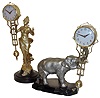 Clocks- 2 (Two) Japan 8 day swing clocks: Diana and elephant figures, late 20th century
 -
 Fuji, Japan, swinging timepiece using the Junghans Diana as a model, the figure with gold finish and mounted to a black painted metal base, polished brass clock case, Arabic numeral metal dial signed "Fuji", polished brass hands, 8 day timepiece movement, c1970
 -
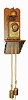 Japanese, double foliot lantern clock, large, "Nicho Tenpu Yagura-dokei", 30 hour, steel framed movement with tooled brass covers, now on a purpose made wall bracket and with later weights
 -
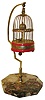 Toyo Clock Factory, Japan, bird cage clock, brass cage on red striped base with brass feet, rotating globe with pointer indicates time, bird attached to end of pallet arbor moves back and forth as clock ticks, the cage suspended from a polished metal hanger mounted to an octagonal marble base, c1930
 -
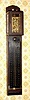 C.1840, Japanese, Stick clock, 1-wt timepiece, top balance with crown-verge escapement and skeletonized front plate, in rosewood case.
 -
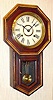 C.1905, Japan, Mini 8-day School Clock, in a faux grained drop octagon case.
 -
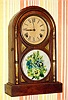 C.1900, Japan, Sankosha, 8-day time/strike shelf clock, copy of the Chicago model.
 -
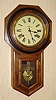 C.1910, Japan, TAKANO CLOCK CO, Nagoya, Mini Oak School Clock, with restorations.