Search Antique Clocks
Showing 3,701–3,720
of 5,197 clocks
from France
-
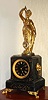 French, Guilmet patent, "MYSTERY" clock, the movement housed in a heavy marble base, and the statue standing on a well hidden carriage that is free to turn back and forth. An arm on the carriage extends into the movement. The pendulum pulls on the carriage in one direction, unlocking the escapement, and then the carriage is given a push in the opposite direction keeping the sequence going, c.1885
 -
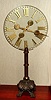 French, Early 20th Century, MYSTERIOUS timepiece, two gilt hands attached to a large glass dial. A Swiss watch movement in each hand, one geared to turn once an hour, the other designed to turn once in 12 hours. See detail fotos of movement and also pivoted counter balance on opposite side of hand.
 -
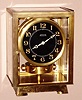 French, J.L. Reutter ATMOS clock, atmospheric driven time only movement with torsion pendulum designed using mercury inside a glass tube similar to that of a thermometer to react to sensitive changes in temperature and atmospheric conditions, Arabic numeral radium painted black dial, sNo. 3705 c1926
 -
 French, uncommon Mystery Timepiece, the clock contained in a drum suspended from two parallel chains, held aloft by a female statue, c1880
 -
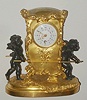 French, c.1880, novelty mantel clock in the form of a gilt sedan, carried by two winged cherubs in black finish, and with a small round movement with platform, serial No. 3678.
 -
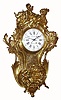 French, Martinot, Paris, very large ormolu cartel clock, the case surmounted by a cherub having spilled out of a chariot pulled by a swan, the bottom of the case showing a reclining Zeus with an eagle at his side, 8-day, time and strike.
 -
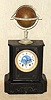 C.1890, French, Edouard Serin, World Time Globe, striking, with phases of the moon and with the name of the retailer, Gowland, Sunderland on the porcelain dial. Uses a unique bell strike movement, with drive mechanism turning at a 90 degree angle from the rear plate and extending up to drive the globe at top. The globe is signed Edouard Serin. There are 24 small porcelain cartouche around the brass ring at the equator.
 -
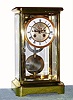 J. Marti and Cie., for Guilmet, crystal regulator 8 day time and strike, with a form of Desfontaines escapement exposed on the dial center, patented 1854, with sweep second's hand, Roman numeral porcelain chapter ring and compound pendulum, c1885. This type of modified Desfontaines escapement is a form of coup perdu (lost beat) escapement that allows for a sweep second's hand to indicate true seconds from a half second's beating pendulum, with the added advantage of constant force impulsing the pendulum
 -
 French, for the English market, C.1910, RICHARD'S CHRONOSPHERE {time globe}, made up of 12 lithographed gores applied to a 7.5" metal sphere, showing Patent 19460, various early 19th C. depictions such as 'Russian Empire' and 'Chinese Empire', the oceans and continents clearly labeled, with nation/states delicately shaded and showing major rivers and cities, shipping routes, etc. The globe is mounted to a bronze stand, with mov't in base.
 -
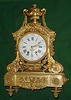 French, Dufaud, Paris, case possibly by Link, C.1890, in the Louis XV style of the previous century, and of the highest quality. There are profuse floral decorations, fruit swags to the sides and acanthus swags drape the top urn w/finial. Large cast and fluted feet support the base.
 -
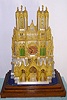 French, Raingo Frs, Paris, bronze, silvered brass and ormolu clock in the form of Reims Cathedral, c.1850. Cathedral of Our Lady in the City of Reims, stands in the Champagne-Ardennes region of France, and is considered one of the finest examples of the High Gothic style of architecture. The kings of France were once crowned in Reims Cathedral. Note that dozens of little cast and chased 'Saints' line the windows, exactly as the real building. Clock sets on its original rosewood base, and with a glass cover/ 5 panes in a wooden frame. Well made silk thread movement is signed as above.
 -
 French bronze figural mantel clock with conical pendulum 8 day time and strike spring driven movement in rouge marble case surmounted by a bronze Classical female figure signed "Laurent" holding a polished silvered turned pendulum rod surrounded by a gilt tube and with a star studded blue spherical bob, the dial with applied Roman numeral gilt chapter ring and exposed skeletonized movement, c1870
 -
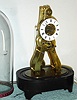 French, for the English market, time and alarm mini skeleton clock, sold at the Great Exhibition of 1851, this one signed on the dial and movement: Pierret, a'Paris, and with a damaged dome. Plates are smooth on this model; see another clock in sale that is engraved.
 -
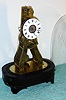 French for the Great Exhibition of 1851, mini skeleton, time and alarm, this model with the front surfaces of the plates engraved, pendulum with a blossom engraved, and the base marked Ms. Honorables, Exp, Paris-Londres, with dome
 -
 French, Japy Freres, ROYAL BONN, porcelain china, LE GRANDE, in attractive shades of magenta with gold highlights and 3 cherubic children on the front panel, shown playing, one with book, another with lyre. The porcelain dial also with fine decorations.
 -
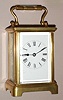 French carriage clock time and half hour strike on gong in corniche case with Roman numeral porcelain dial, c1910
 -
![French, Brass Cased Carriage Clock, Petite Sonnerie [strikes ding dong quarters and repeats quarters and hours, with a silence lever in the base], also w/ alarm, top bearing a presentation engraved for year 1904, and with carry case w/ latched lid.](/images/robertoschmitt19/ts_2587_a.jpg) French, Brass Cased Carriage Clock, Petite Sonnerie [strikes ding dong quarters and repeats quarters and hours, with a silence lever in the base], also w/ alarm, top bearing a presentation engraved for year 1904, and with carry case w/ latched lid.
French, Brass Cased Carriage Clock, Petite Sonnerie [strikes ding dong quarters and repeats quarters and hours, with a silence lever in the base], also w/ alarm, top bearing a presentation engraved for year 1904, and with carry case w/ latched lid. -
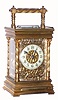 French, brass cased time, strike and repeat carriage clock, in an attractive case with candy twist columns and handle, and with a lovely floral mask surrounding the porcelain dial, c.1900
 -
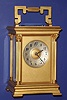 French, Brass Cased Carriage clock, large, over 10 inches tall, retailed by Folkard and Son, Brighton, and in a 4-column Anglaise style case, 8-day time and gong strike.
 -
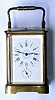 French, brass cased Carriage Clock, c.1900, GRAND SONNERIE, with slector in base for Pte Sonnerie, Silence and Gde Sonnerie, and with alarm and repeat. Fancy dial with black numerasl and blue decorations.