Search Antique Clocks
Showing 301–320
of 1,580 clocks
from England
-
 James Tregent, Leicester Square, London, tall case clock, 8 day, time and strike, weight driven movement in a mahogany case with pagoda top with stop fluted columns, three brass finials, trunk with stop fluted quarter columns and brass capitals flanking the molded tombstone door, the base with frame molded center and straight bracket feet, composite brass dial with silvered chapter ring, four seasons spandrels, maker's boss, calendar aperture above 6 and strike / silent selector, brass clad penjdulum and weights
 -
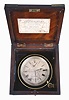 Richard Hornby and Son, Liverpool, a two day marine chronometer unusual balance and spring, 11 jewel, free sprung fusee movement with Earnshaw's spring detent, uncut monometallic balance with quarter screws and four cylindrical, adjustable weights and white helical balance spring, Roman numeral silvered dial with wind indicator, blued steel spade and poker hands, contained in a lacquered brass bowl with gimbals, and mounted in a mahogany and mahogany veneer box with brass furniture, serial #1341, and also with labels of Francis Moore, Chronometer and Watch Maker, Belfast, and F. Rotig, Havre
 -
 Thomas Vurleyl, Wisbeack, England, tall case clock, 8 day, time and bell strike, weight driven movement, c. 1840, in a c. 1780 string inlaid mahogany case with pagoda top, brass finials, crotch mahogany trunk door, fluted columns flanking hood.
 -
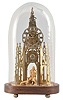 England, Sir Walter Scott Memorial brass skeleton clock, unsigned, the brass frame of cathedral form with pierced and silvered roman numeral chapter ring, chain fusee eight day, five train movement with maintaining power and lever escapement with regulation sector and hand all on a walnut base with gilt figures of Sir Walter Scott and his dog, beneath a glass dome.
 -
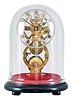 England, skeleton timepiece with center seconds and platform escapement, pierced, triple Venn diagram frame, Roman numeral silvered dial, blued steel spade and poker hands, 8 day fusee movement with 7 jewel lever platform and brass balance, all on a turned, ebonized base with glass dome
 -
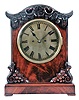 English Victorian Table Clock, with engraved brass roman numeral dial and blued spade hands, brass bezel and beveled glass, figured mahogany case with carved serpentine top featuring scrolls, flowers and leafage, chamfered corners flanking the dial, ogee-shaped buttresses with oak leaves and acorns on the facade, pierced sound vents on the sides, all resting on a molded base with pad feet, eight day, brass fusee spring-powered movement with recoil escapement and hour strike on a gong.
 -
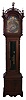 Ty Burtt, England, tall case clock, 8 days, time and gong strike, brass weight driven movement in an inlaid cherry case with with fret work hood, brass finials including eagle center, full turned columns flanking hood, beveled glass trunk door flanked by full columns and applied bracket base. The brass dial has silvered chapter ring, applied brass numerals, moon phase and date calendar
 -
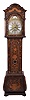 Thomas Watson, Haslingden, England tall clock, 8 day, time and bell strike, weight driven movement now in a Dutch marqueterie veneered bombay style case profusely inlaid with glazed aperture for pendulum bob on bun feet. The brass dial has a silvered chapter ring and silvered maker's boss above 12, cast brass spandrels and silvered calendar disk above 6.
 -
 H. Cain, Luton, England, tall clock, 8 day, time, strike and calendar, weight driven movement pagoda top oak case with painted metal dial, painted spandrels and rocking Father Time
 -
 John Green, Skipton, England tall clock, 8 day, time and gong strike, weight driven movement in a chinoiserie oak case with carved coffin top, three quarter columns on hood door and quarter columns on rear of hood on applied molded base. The brass dial has an applied reticulated arch with putti holding a crown, applied cast brass spandrels and calendar and maker's signature above 6.
 -
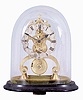 England, single fusee skeleton clock, in a well finished scroll frame, and with scalloped dial of silvered brass, nice small size, height of frame only approx. 8"
 -
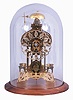 England, signed Smith, Clerkenwell, c1890 chain fusee pub movement, now in a modern skeletonized frame representing Brighton Pavilion, the frame appearing to have been cut on an EDM wire machine, and then polished by hand. The silvered dial is nicely fretted and the Roman Numerals are sharply engraved and black filled. The frame surmounted by a bell that is struck once on the passing of each hour. Covered by a round glass dome and mounted on a turned walnut base.
 -
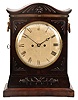 Mackduff, London, a Regency two train bracket clock, brass inlaid mahogany case with applied carved ornament and serpentine top, the sides with brass fish scale frets and ring handles with stamped rosettes, brass bezel with convex glass, Roman numeral white enamel dial blued steel Breguet style hands, 8 day, time and strike brass fusee movement with shouldered plates, counting the hours on a bell
 -
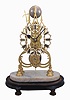 England, 3 spire Gothic frame, single chain fusee brass skeleton clock, with eight day, passing hour single bell strike, fretted roman numeral dial, all on a marble stand and wooden pedestal, lacking a dome.
 -
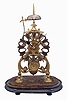 England, late 19th Century, passing strike skeleton clock, in a fretted brass scroll frame, no dome.
 -
![England, 3 spire Gothic frame, single fusee skeleton clock, with a silvered fretted dial, passing strike [single bell on the hour], no dome, mounted to a rectangular wooden base.](/images/robertoschmitt34/t17715_a.jpg) England, 3 spire Gothic frame, single fusee skeleton clock, with a silvered fretted dial, passing strike [single bell on the hour], no dome, mounted to a rectangular wooden base.
England, 3 spire Gothic frame, single fusee skeleton clock, with a silvered fretted dial, passing strike [single bell on the hour], no dome, mounted to a rectangular wooden base. -
 John Bell, Hexham, England, 30 hour, time and bell strike, single weight driven movement, c. 1830, in an American walnut case with three brass finials and painted metal dial
 -
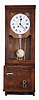 The Gledhill-Brook Time Recorders Ltd., Huddersfield Halifax, London, Birmingham, time recorder punch wall clock, 8 day, time only, spring driven movement in an oak case with painted metal dial including punch card holder
 -
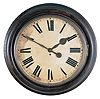 England, gallery wall clock, 8 day, time only, spring driven movement with fusee in an oak case with painted metal dial
 -
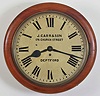 England, 8 day, spring brass fusee movement gallery timepiece.