Search Antique Clocks
Showing 121–140
of 156 clocks
type Shelf or Mantel Skeleton
-
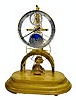 Contemporary Skeleton Clock W/Moon Phase
 -
![C.1825, Scottish, R. [Robert] Wilkie, Cupar-Fife, WORLD TIME skeleton clock, with conventional 12 hour dial on one side and 24 dial opposite engraved with approx 52 major worldwide locations, single bell passing strike, fusee and large great wheel.](/images/robertoschmitt15/t218.jpg) C.1825, Scottish, R. [Robert] Wilkie, Cupar-Fife, WORLD TIME skeleton clock, with conventional 12 hour dial on one side and 24 dial opposite engraved with approx 52 major worldwide locations, single bell passing strike, fusee and large great wheel.
C.1825, Scottish, R. [Robert] Wilkie, Cupar-Fife, WORLD TIME skeleton clock, with conventional 12 hour dial on one side and 24 dial opposite engraved with approx 52 major worldwide locations, single bell passing strike, fusee and large great wheel. -
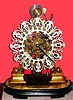 C.1870, English, Joseph Mayer, Lord St., Liverpool, (1803--1886) 3-Tr, 8-Bell Skeleton Clock in a heavy scroll frame, and a display case (original cracked dome included).
 -
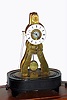 C.1851, French, Pierret, Paris, 8-day skeleton timepiece with alarm with silk thread suspension made for the Great Exhibition in Hyde Park, London in 1851, under larger glass dome.
 -
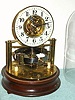 C.1912, English, Reason Mfg, Brighton, Electrically impulsed balance wheel clock, a skeleton layout on a mahogany base, under glass dome, made to the 1911 patent design of Thomas John Murday.
 -
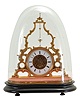 France, skeleton clock with conical pendulum, the triangular, openwork gilt frame ornamented with c scrolls and foliage, Roman numeral white enamel dial, blued steel Breguet style hands, 8 day timepiece movement, the back plate marked "Medaille de Bronze" beneath an eagle, gilt pendulum with silver plated ball, all resting on a velvet lined, ebonized wooden base, and covered with a glass dome
 -
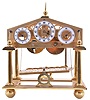 English, "Rolling Ball" mantel clock, on older wood base. unsigned, (no glass cover)
 -
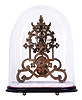 England, Skeleton clock, nicely pierced and finished brass scroll frames, Roman numeral skeletonized dial with shield shaped reserves for the figures, blued steel hands, 8 day fusee timepiece with 6 spoke crossings, recoil escapement, and brass pendulum with steel rod, all mounted to a marble plinth with ebonized wooden base, and with period shade
 -
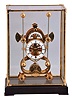 Asian brass reproduction of Harrison H1 marine clock, grasshopper escapement, 8 days, time only, with fusee, porcelain chapter ring, stained wood base, glass and brass cover; late 20th century
 -
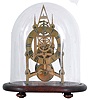 England, small Gothic skeleton clock, the pierced brass frame with 6 turned baluster form pillars, engraved Roman numeral brass dial, blued steel hands, and 8 day fusee timepiece movement, mounted to an oval mahogany base with glass dome.
 -
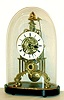 English, attributed to W. F. Evans, a single chain fusee skeleton clock, striking a single bell tone at the hour, and with optional white porcelain enamel dial {that makes reading the time much easier}, mounted to an oval wooden base, and with old /period glass dome, c1870
 -
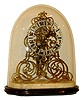 English, single fusee skeleton timepiece, in an extra fancy scrolling frame, with pierced silvered dial and glass dome, c1870
 -
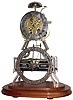 Clocks- 3 (Three) 8 days, modern Asian reproduction exotic brass skeleton clocks with glass domes: scissors; calendar; and Harrison; late 20th century
 -
![J. Smith and Sons Clerkenwell, [attributed] skeleton clock, cathedral form plates with delicate piercing and decorative turned baluster form pillars, on ball feet and with stepped base, engraved Roman numeral silvered dial with pie crust edge, blued steel hands, brass pendulum with decorative star form steel ornament at center, 8 days, single fusee movement with recoil escapement and passing strike, all mounted to a velvet lined ebonized wooden base with glass dome, c1850](/images/robertoschmitt27/t7409_a.jpg) J. Smith and Sons Clerkenwell, [attributed] skeleton clock, cathedral form plates with delicate piercing and decorative turned baluster form pillars, on ball feet and with stepped base, engraved Roman numeral silvered dial with pie crust edge, blued steel hands, brass pendulum with decorative star form steel ornament at center, 8 days, single fusee movement with recoil escapement and passing strike, all mounted to a velvet lined ebonized wooden base with glass dome, c1850
J. Smith and Sons Clerkenwell, [attributed] skeleton clock, cathedral form plates with delicate piercing and decorative turned baluster form pillars, on ball feet and with stepped base, engraved Roman numeral silvered dial with pie crust edge, blued steel hands, brass pendulum with decorative star form steel ornament at center, 8 days, single fusee movement with recoil escapement and passing strike, all mounted to a velvet lined ebonized wooden base with glass dome, c1850 -
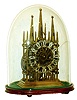 English double fusee, striking skeleton clock, in the form of Litchfield Cathedral, with a pierced & silvered silvered dial, c1870
 -
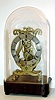 English, a single fusee skeleton timepiece, with a simple solid brass chapter ring, in a "Lyre" style frame, and with robust baluster pillars, on a rosewood veneered base with glass dome, c1860
 -
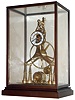 Skeleton Clock, modern Asian lacquered brass reproduction, in glass and wood case, late 20th century
 -
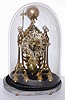 English single fusee skeleton clock, passing strike, with oval glass dome, George Washington decorated pendulum and marble base, c1870
 -
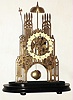 Skeleton clock, Chinese, in a cathedral frame, modern copy of English double fusee original, less dome, c.2002
 -
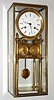 French skeleton clock, the c. 1820 spring powered time and strike movement with silk thread suspension, heavy molded brass bezel and white enamel dial, blued steel Breguet style hands, mounted to a later stand with calendar, bearing a spurious signature, covered with a purpose made, glazed rectangular dome with brass frame.