Search Antique Clocks
Showing 861–880
of 13,386 clocks
type Shelf or Mantel
-
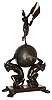 French bronze figural clock, "Lady Liberty", 8 day, time and strike, spring driven movement with platform escapement all on a marble base (not pictured), c1900
 -
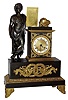 French bronze and ormolu figural mantel clock, 8 day, silk thread suspension, time and bell strike, spring driven movement with unusual automatic beat adjustment designed to keep the pallets centered by gravity on the pallet arbor in well patinated case with Roman figure holding tablet with the title of Virgil's works, accented with ormolu appliques and spandrels with a musical motif and a Roman numeral white enamel chapter ring, c1810
 -
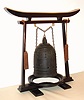 A rare and early Japanese bell clock (Tsurigane Dokei) within a finely cast bronze bell with Japanese characters and double headed dragon form handle; having a posted, iron, double spring driven, striking movement with crown wheel escapement and time regulated by a large circular balance with moveable double weights, originally for adjusting the temporal hours every day before each sunrise and sunset with the change of each Japanese season. The brass dial with single, fixed hand has traditional Japanese numerals 9 through 4 with applied silvered butterflies to the original surrounding dial plate. The rotating dial with adjustable "hour" and "half hour" markers is a common 19th Century upgrade to many very early Japanese clocks that have a single foliot or balance, since changing the weights and hence the rate before sunrise and sunset each day was extremely unhandy. This is verified by J. Drummond Robertson in The Evolution of Clockwork , page 226 saying "we find some of the old clocks "converted" to the new style of motion work. The old fixed hour circle with its revolving centre was removed and the new revolving circle and its fixed hand with adjustable "hour" plates was substituted." This is the case in each of the only other examples of Japanese Bell Clocks of which we are aware: see Japanese Clocks by N.H.N. Mody, plate 113, fig.1 for an almost identical example to the clock being offered. This dial conversion is also apparent in the Bronze Bell Clock sold at Sotheby's Masterpieces From the Time Museum Sale, Part Two, 19 June 2002, lot 126. An inscription on the bell reads Fukushima ya Katsutaro 1689, who may be the maker of either the clock or the bell. Most Japanese spring driven clocks have a fusee to the time train and a going barrel to the strike train. This movement is anomalous, in that is has two going barrels. It may be that the Japanese had not developed a method of turning a fusee at this early date, C.1690
 -
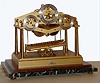 Dent, London, England, "Congreve Rolling Ball Clock", 8 day, spring driven, fusee movement with maintaining power is regulated by a rolling steel ball traversing an inclined plane every 15 seconds, tripping a lever, tilting the plane in the opposite direction, while registering 15 second intervals on the right dial, minutes on the center and hours on the left all on a marble base in a Plexiglass case, dated 1973
 -
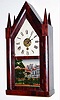 Silas B. Terry, Terryville, Conn., 30 hour time and strike tandem wind steeple clock, c1850. This is a very rare model using a single arbor to wind the time and strike side of the clock. A similar example can be found on page 184 in "Horology Americana" by Dworesky and Dickstein.
 -
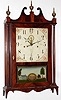 Eli Terry, Plymouth, Conn., 30 hour time and strike model 3 outside escape pillar and scroll shelf clock, c1819
 -
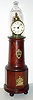 Hugh Witham, Owosso, Michigan, "Willard Lighthouse" reproduction clock, 8 day, time only, weight driven movement by John Gass, Holt, Mich. (stamped on movement) in mahogany veneer case with porcelain dial made in London, England signed "SIMON WILLARD ROXBURY" with blown gloss dome manufactured by the London School of Glass Blowing, c1979 s#3
 -
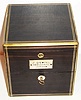 England, chronometer no. 4653 by J. Sewill, London, two day fusee movement with spring detent escapement, chronometer balance with helical hairspring, spotted plates, silvered Roman numeral dial with Arabic five minute markers, up/ down indicator, dial signed J. Sewill, 30 Cornhill, Royal Exchange, London, Maker to the Admiralty, also marked with mention of awards received in London 1862 and Paris 1867, blued steel seconds hand, gold hour and minute hands, lacquered brass bowl in gimbals with locking lever, ratchet type key correct and possibly original, beautiful ebony box with brass binding and hardware, mother of pearl plate on front of box marked J. Sewill 30 Cornhill London c1870
 -
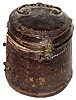 German, Tisch Uhr or table clock by Wilhelm Heilmann, Altenburg, time and bell strike in a gilt brass case, verge and balance escapement, and with original travel case, C1800
 -
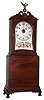 Massachusetts Shelf Clock, 8 day, weight driven, timepiece with alarm, c1815
 -
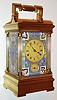 France, eight day hour repeating time, probably strike and alarm carriage clock, Anglaise Riche case with very nice champleve enamel panels, the foliate design in bright blues, greens, and reds, beveled glass in back door and top, matte gilt Roman numeral dial, blued steel hands, movement with silvered lever platform, c1880
 -
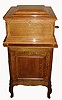 Regina Music Box Co., Rahway and Jersey City, N.J., Style No.11, table top 15 Ohm inch, double comb, disc playing music box, quarter sawn oak case with mother of pearl dot and white line inlays, stepped molded top, and molded base supported on turned ball feet, inside of lid with orig label from C. J. Heppe and Son, Philadelphia, and Regina label, together with a quarter sawn oak disc storage cabinet with 15+ discs, bedplate serial #55312, c1900
 -
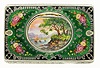 German bird box with engraved sterling silver case, top with engraved border and colorful enamel with floral decoration, the lid with a colorful rural landscape with sailboats on a lake, the bird with multi colored feathers, with original key, late 20th century
 -
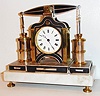 France, small industrial beam engine desk clock by Guilmet, eight day time only movement, back plate marked Medialle D'Or GLT Paris, white enamel Roman numeral dial with blued steel Breguet style hands, the engine with bright and patinated silver and gold surfaces, mounted on a white marble base with turned brass feet, c1880
 -
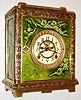 New Haven Clock Co., New Haven, Conn., "No. 1017" model, Asian influenced cast bronze case with green Aesthetic period Chelsea art tiles manufactured by J and G Low, Chelsea, Mass., the tiles depicting clouds, hovering and flying putti, and an hourglass, white enamel Arabic numeral dial, blued steel hands, cast bezel with beveled glass, 8 day, time and strike, movement with Brocot open escapement, c1885
 -
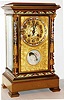 France, for Wright, Kay and Co., Detroit, eight day time and strike crystal regulator in a large size, polished brass case with columns, columns and case with champleve enamel ornament, gilt dial mask decorated with engraved acanthus leaf on a matted ground, pierced and engraved gilt dial with Arabic numerals and champleve border, with a well executed portrait miniature of a fashionable young woman below the six, blued steel hands, four beveled glass panels, round French movement with Brocot escapement, striking the hours and half hours on a gong, mercury pendulum c1880
 -
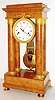 Brocot, France, large portico clock with pinwheel escapement, round time and strike movement with large barrels, possibly of two week duration, count wheel striking on a bell, crutch with fine beat adjustment, white enamel dial signed "Brocot", gilt Breguet style hands, with sweep seconds, heavy gilt brass and steel gridiron pendulum with knife edge suspension beating half seconds, the case veneered in figured ash, with gilt bezel, column mounts, and feet, with gilt beat scale, c1830
 -
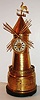 French Industrial, windmill, the polished brass case with black marble base, mid section with pierced gallery, topped with a weathervane, lower section with two simulated windows flanking a door, which slides up to allow separate windmill movement to be wound, with eight day time only movement with cylinder platform, silvered Roman numeral dial with gilt center, and blued steel spade hands, c1870
 -
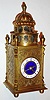 France, grand sonnerie striking desk or table clock, the engraved and gilt case in the style of early 17th century German work, French eight day time and strike carriage clock movement, striking and repeating on gongs, with lever platform escapement, white enamel Arabic numeral dial with blue enamel center, steel hands, back of case marked "Planchon au Palais Royal", sonnerie/ silence controlled by lever under case, c1910
 -
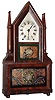 Birge and Fuller, Bristol, Conn., 8 day, time and strike wagon spring steeple on frame with candle finials shelf clock, c1845