Search Antique Clocks
Showing 621–640
of 9,253 clocks
type Shelf
-
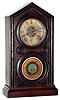 E. Ingraham, Bristol, Conn. "Doric" 8 day time, strike and alarm rosewood mantel clock, c1880
 -
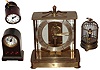 Clocks- 4 (Four) German novelties three thirty hour and one electronic, 20th century
 -
 Clocks- 3 (Three): two German Black Forest modern 30 hour cuckoo clocks, c1980 and an United Electric Clock Co., Brooklyn, Roosevelt 30 hour novelty clock, c1940
 -
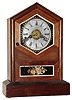 Jerome and Co., New Haven, rosewood 30 hour time, strike and alarm cottage clock, c1875
 -
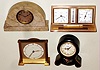 Clocks- 4 (Four) German small rear wind desk clocks: one has music box and one striking, 20th century
 -
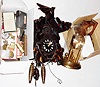 Clocks- 2 (Two) and watch and clock parts and tools: a modern cuckoo a Shulz 400 day clock, watch and clock movements, tools and spare parts
 -
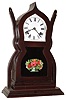 Reproduction hand made 8 day time and strike acorn style shelf clock, later 20th century
 -
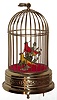 German two singing birds in a brass cage, later 20th century
 -
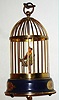 German singing bird in painted brass cage, c1960
 -
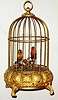 German pair of singing birds in a fancy bejeweled brass cage, 20th century
 -
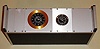 Patek Philippe, Geneve, integrated Electronic Master Clock System in two module tower with quartz movements and black dials, c1975
 -
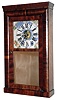 E. C. Breswter for Daniel Pratt, Jr., Reading, Mass., 8-day time and strike Iron back plate movement shelf clock, c1842.
 -
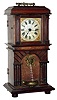 Hamburg American Clock Co., Germany, water fountain 30 hour walnut novelty mantel clock, c1900
 -
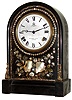 Anglo-American, 8 day, time and strike, ebonized case with MOP inlay mantel clock, c1860
 -
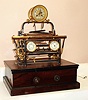 French, Guilmet, rare automaton "LOOM" from the industrial series, a conventional time and bell strike movement, with the exposed gears and loom driven by a weight falling down the right side of the base, the "motor" for the loom, a large heavily made clockwork movement with dual vane fan governor. Typical of Guilmet's designs, the loom includes a thermometer to the left and an aneroid barometer to the right , c1880
 -
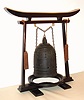 A rare and early Japanese bell clock (Tsurigane Dokei) within a finely cast bronze bell with Japanese characters and double headed dragon form handle; having a posted, iron, double spring driven, striking movement with crown wheel escapement and time regulated by a large circular balance with moveable double weights, originally for adjusting the temporal hours every day before each sunrise and sunset with the change of each Japanese season. The brass dial with single, fixed hand has traditional Japanese numerals 9 through 4 with applied silvered butterflies to the original surrounding dial plate. The rotating dial with adjustable "hour" and "half hour" markers is a common 19th Century upgrade to many very early Japanese clocks that have a single foliot or balance, since changing the weights and hence the rate before sunrise and sunset each day was extremely unhandy. This is verified by J. Drummond Robertson in The Evolution of Clockwork , page 226 saying "we find some of the old clocks "converted" to the new style of motion work. The old fixed hour circle with its revolving centre was removed and the new revolving circle and its fixed hand with adjustable "hour" plates was substituted." This is the case in each of the only other examples of Japanese Bell Clocks of which we are aware: see Japanese Clocks by N.H.N. Mody, plate 113, fig.1 for an almost identical example to the clock being offered. This dial conversion is also apparent in the Bronze Bell Clock sold at Sotheby's Masterpieces From the Time Museum Sale, Part Two, 19 June 2002, lot 126. An inscription on the bell reads Fukushima ya Katsutaro 1689, who may be the maker of either the clock or the bell. Most Japanese spring driven clocks have a fusee to the time train and a going barrel to the strike train. This movement is anomalous, in that is has two going barrels. It may be that the Japanese had not developed a method of turning a fusee at this early date, C.1690
 -
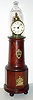 Hugh Witham, Owosso, Michigan, "Willard Lighthouse" reproduction clock, 8 day, time only, weight driven movement by John Gass, Holt, Mich. (stamped on movement) in mahogany veneer case with porcelain dial made in London, England signed "SIMON WILLARD ROXBURY" with blown gloss dome manufactured by the London School of Glass Blowing, c1979 s#3
 -
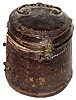 German, Tisch Uhr or table clock by Wilhelm Heilmann, Altenburg, time and bell strike in a gilt brass case, verge and balance escapement, and with original travel case, C1800
 -
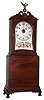 Massachusetts Shelf Clock, 8 day, weight driven, timepiece with alarm, c1815
 -
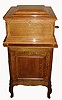 Regina Music Box Co., Rahway and Jersey City, N.J., Style No.11, table top 15 Ohm inch, double comb, disc playing music box, quarter sawn oak case with mother of pearl dot and white line inlays, stepped molded top, and molded base supported on turned ball feet, inside of lid with orig label from C. J. Heppe and Son, Philadelphia, and Regina label, together with a quarter sawn oak disc storage cabinet with 15+ discs, bedplate serial #55312, c1900