Search Antique Clocks
Showing 21–40
of 46 clocks
type Tower
-
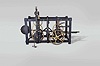 Tower clock, birdcage model of the late 18th century, time and strike, weight driven movement with pinwheel escapement in a cast iron frame
 -
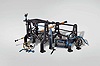 Friedrich E. Korfhage, KG, Neue Turmuhren und Maschinenfabrik, Buer Bez. Osnabruck, Germany, tower clock, time and strike on two separate cast iron frames, electrically wound movement also in its own cast iron frame
 -
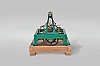 Europe, tower clock, time only, weight driven movement with double three legged gravity escapement in a green painted cast iron frame, mounted on wooden cradle.
 -
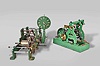 Tower or Street Clock Movements- 2 (Two) small with deadbeat escapement in green paint: (1) Time only; (2) Time and strike
 -
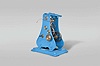 England, tower or street clock, time only, weight driven movement with anchor escapement signed on both blue painted cast iron plates W.H. BAILEY & CO LTD, MANCHESTER
 -
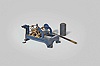 European, tower clock or street clock, time only, weight driven movement with deadbeat escapement in painted blue cast iron frame with pendulum
 -
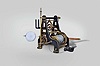 European, tower or street clock, time only, weight driven movement with anchor escapement in painted cast iron frame with transmission parts attached
 -
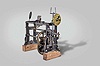 J. Iml. Perrot, Calw, Germany, tower or street clock, time only movement with anchor escapement in a cast iron frame
 -
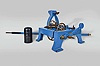 Midland Clockworks, J. Smith & Sons, Derby, England tower or street clock, time only, weight driven movement with pinwheel escapement in blue painted cast iron frame
 -
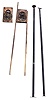 Stephen Hasham, Charlestown, New Hampshire, 2 (Two) tower clock motion works, wooden frames, brass gears and steel bridge along with 2 (Two) wooden and beveled geared linkage pieces.
 -
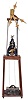 E. Howard & Co., Boston, Mass., "Special Timepiece No. 0", tower clock movement, 8 day, time only, 110 pound weight driven movement capable driving of driving four dials with two sets of tin tower clock hands and an associated motion works
 -
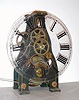 E. Howard and Co., Boston, Mass., "Street or Small Tower" timepiece movement, less pendulum and weight. No distribution, c1890
 -
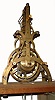 English, Street or small tower timepiece movement, nice scroll frame, and with Graham's dead beat escapement (jeweled pallets) and maintaining power, complete with a canister style pendulum (no mercury) and large brass covered weight, no hands nor dial, eight day duration (need several feet for weight to drop), mounted to a molded edge plank of oak, and probably meant for a window display. C.1900.
 -
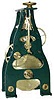 E. Howard tower clock, ca 1890.
 -
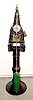 Seth Thomas No. 4 Clock Tower Works
 -
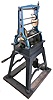 Nels Johnson, Manistee, Michigan, "Century" tower clock No. 1, originally installed in the Lyman Block building, Manistee, Michigan, the single train timepiece with paint decorated cast iron frames, Graham dead beat escapement, involute gearing, and Harrison's maintaining power, mounted to a black painted, cast iron base, with Johnsons bi metallic, compensating pendulum, cast iron crank with rosewood handle, and distribution network for four dials, together with the zinc finial from the Lyman tower
 -
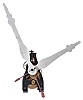 E. Howard & Co., Boston, Mass., "No. 00 Timepiece" tower or street clock, 8 day, time only, weight driven movement including one set of wooden tower clock hands, motion works, weights and pendulum
 -
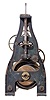 E. Howard & Co., Boston, Mass., "No. 00 Timepiece" tower or street clock, 8 day, time only, weight driven movement including two sets of wooden tower clock hands, motion works and pendulum
 -
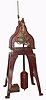 Seth Thomas Clock Co., "Tower Clock No. 6" Movement on another size stand, with winding crank and 2 smaller18-lb iron weights, pendulum length of 48" and iron bob weight of 75 pounds, c1890
 -
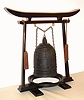 A rare and early Japanese bell clock (Tsurigane Dokei) within a finely cast bronze bell with Japanese characters and double headed dragon form handle; having a posted, iron, double spring driven, striking movement with crown wheel escapement and time regulated by a large circular balance with moveable double weights, originally for adjusting the temporal hours every day before each sunrise and sunset with the change of each Japanese season. The brass dial with single, fixed hand has traditional Japanese numerals 9 through 4 with applied silvered butterflies to the original surrounding dial plate. The rotating dial with adjustable "hour" and "half hour" markers is a common 19th Century upgrade to many very early Japanese clocks that have a single foliot or balance, since changing the weights and hence the rate before sunrise and sunset each day was extremely unhandy. This is verified by J. Drummond Robertson in The Evolution of Clockwork , page 226 saying "we find some of the old clocks "converted" to the new style of motion work. The old fixed hour circle with its revolving centre was removed and the new revolving circle and its fixed hand with adjustable "hour" plates was substituted." This is the case in each of the only other examples of Japanese Bell Clocks of which we are aware: see Japanese Clocks by N.H.N. Mody, plate 113, fig.1 for an almost identical example to the clock being offered. This dial conversion is also apparent in the Bronze Bell Clock sold at Sotheby's Masterpieces From the Time Museum Sale, Part Two, 19 June 2002, lot 126. An inscription on the bell reads Fukushima ya Katsutaro 1689, who may be the maker of either the clock or the bell. Most Japanese spring driven clocks have a fusee to the time train and a going barrel to the strike train. This movement is anomalous, in that is has two going barrels. It may be that the Japanese had not developed a method of turning a fusee at this early date, c1690