Search Antique Clocks
Showing 21–40
of 95 clocks
by Willard
-
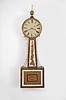 Perhaps Simon or Aaron Willard, Boston, Mass., 8 day, weight T-bridge brass movement banded case patent or banjo or wall timepiece
 -
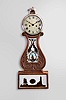 Lyre banjo, period elements, time, strike and alarm,
 -
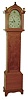 Alexander T. Willard, Ashby, Mass., tall clock, 30 hours, time and strike, weight driven, wooden works movement in a pine case with full columns and three chimneys on hood and painted wooden dial, c1810
 -
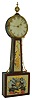 Aaron Willard Jr., Boston, Mass., (attributed), banjo wall clock, 8 days, time only, weight driven movement in a mahogany veneer and cross banded case with reverse painted throat and lower glass tablets and painted metal dial, c1820
 -
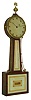 Massachusetts, 8 day, weight brass movement banded mahogany case patent or banjo timepiece, c1812. This timepiece could be by Aaron Willard, Jr., as an example of the movement in this timepiece matches one pictured in "Willard's Patent Timepieces" by Paul Foley, pg 51 showing the three spoke hour wheel.
 -
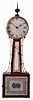 Boston 8 days, weight driven brass movement patent or banjo timepiece, c1825. Possible Simon Willard banjo as it is early with a head that is a uniform 1/2 inch thickness and has a very thin backboard. The movement has T-bridge suspension, through bolts to secure the movement. There are holes in the keystone for a crossbar. The throat frame is rabbeted on the back side and recessed into the sides of the case and anchored to the case with four screws. The door is latched to the case with an L-turn.
 -
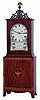 Reproduction Aaron Willard inlaid mahogany, 8 days, time only weight driven Massachusetts-style shelf clock, c1940
 -
 The Henry Ford Museum, Dearborn, Michigan reproduction Simon Willard, Boston, Mass., tall case clock, 8 day, time, strike and triple chime, weight driven movement in a mahogany Roxbury style case with three brass finials, fretwork top, fluted full columns on hood with brass terminals, string inlay, fluted corner columns on trunk with brass terminals, ogee feet and moon phase dial
 -
 The Henry Ford Museum, Dearborn, Michigan reproduction Simon Willard, Boston, Mass., tall case clock, 8 day, time, strike and triple chime, weight driven movement in a mahogany Roxbury style case with three brass finials, fretwork top, fluted full columns on hood with brass terminals, string inlay, fluted corner columns on trunk with brass terminals, ogee feet and moon phase dial
 -
 C.1830, Boston Area Lyre Banjo, now with a dial from the same period, with an original signature of Aaron Willard Jr., Boston, 2 extra holes in "head".
 -
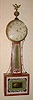 C.1815, Attributed to Simon Willard, Boston banjo, 1-weight, 8-day, with step train, T-bridge movement held in place with original fillister screws.
 -
![C.1816 [dated], Aaron Willard, Mass Shelf Clock, 2-wt, 8-day bell strike.](/images/robertoschmitt11/t322.jpg) C.1816 [dated], Aaron Willard, Mass Shelf Clock, 2-wt, 8-day bell strike.
C.1816 [dated], Aaron Willard, Mass Shelf Clock, 2-wt, 8-day bell strike. -
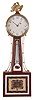 Attributed to Aaron Willard, Jr., Roxbury, Massachusetts, patent timepiece or "banjo" clock with hermometer, the mahogany case with brass eagle finial over the unmarked, painted iron roman numeral dial, held in place by three "L" shaped screws, superb original steel barbed hands, the cross-banded throat section with reverse-painted glass signed "Willard's Patent" in the lower cartouche, red and green decoration frames the thermometer with graduations from minus 40 to 260 degrees Fahrenheit and notations from "Extreme Cold" to "Water Boils", the lower glass framed with cross-banding also marked "Willard's Patent" in a banner above the pendulum aperture, red, green, gold and mustard decoration complete a geometric design bordered in white, eight day timepiece with t bridge suspension, recoil escapement, alternate train layout, holes remaining for through bolts for movement attachment to the case, all powered by a lead weight and regulated by a pendulum.
 -
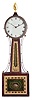 Attributed to Aaron Willard, Jr., Roxbury, Massachusetts, mahogany patent timepiece or "banjo" clock, iron roman numeral dial, brass bezel, side ornaments flanking the waist section, waist and box with cross banded frames for the reverse-painted glasses, the waist with gold floral and leafage decoration framing a central classical urn with climbing vine, the lower glass marked "Patent" within a centered rectangular panel with central aperture for pendulum viewing and leafage tied with a ribbon against a green ground, eight day timepiece movement with t bridge suspension, step train, and through bolts for case attachment, all powered by a period lead weight, regulated by a pendulum with steel rod and brass-faced bob, and period winding key. Provenance: J.T. Vogdes, Philadelphia as indicated by a printed label on the backboard of the case.
 -
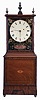 Aaron Willard, Boston, Massachusetts, dish dial mahogany shelf clock, reverse-painted glass with shields, stenciled flowers and lower cartouche inscribed "Aaron Willard/Boston" all over the iron roman numeral dish dial, the lower veneered wooden panel with line and central marquetry inlay resting on the flat veneered base and brass ball feet, eight day time only brass movement with pendulum and lead weight.
 -
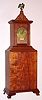 Massachusetts Shelf clock, a copy of an early Willard primitive shelf clock. This example made in 1981 by a J. Garbus using a Kilbourn and Proctor 8-day short drop rear mount weight movement. Circa 1981.
 -
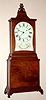 Massachusetts Shelf clock, copy of an Aaron Willard example with an 8-day front mount pendulum banjo style weight movement. Circa 1960
 -
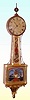 Boston area banjo, T-Bridge movement, possibly by A. Willard, Jr, slender round head, dial to edge of head, 8-day, weight, barb hands, with restorations. C.1825.
 -
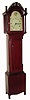 C.1825 Alexander T. Willard, Ashby, Mass., 30-hour time/strike tall clock.
 -
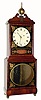 C.1815, Aaron Willard, Massachusetts Shelf, in outstanding restored condition.