Search Antique Clocks
Showing 61–80
of 125 clocks
by Smith
-
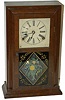 Miniature reverse OG shelf clock by Smith and Goodrich, ca 1847 - 1851, which were the only years this company was in business.
 -
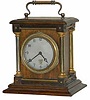 Smiths Clock Co. London, wood carriage clock.
 -
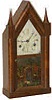 Smith and Goodrich, Bristol, Conn. double fusee, sharp Gothic clock, ca 1847-1851.
 -
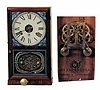 Smith & Goodrich, Bristol, Conn, ca 1847. A double fusee shelf clock.
 -
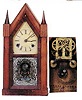 Smith & Goodrich, Bristol, Conn. Early steeple clock, ca 1844.
 -
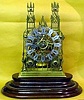 Fine double fusee skeleton striking on a gong,
 -
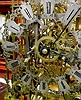 Fine double fusee skeleton striking on a gong, in the "York Minster" pattern,
 -
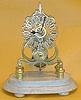 Skeleton in scroll frame by Smith's of Clerkenwell
 -
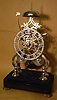 Striking skeleton clock - double fusee -
 -
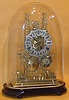 Timepiece skeleton by Smith of Clerkenwell
 -
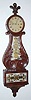 C.1832, Jesse Smith, Jr., Salem, Mass., 8-day time and bell strike lyre form or "Elegant Harp Pattern" timepiece. Smith worked from 1811 to 1866. An apprentice of Benjamin Balch in Salem and in 1818-32 was in partnership with him as Balch and Smith.
 -
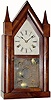 C.1848, Smith and Goodrich, Bristol, Conn., 30-hour time/strike mahogany steeple clock, in very good condition.
 -
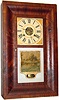 C.1840, Henry C. Smith, Plymouth, Conn, 30-hour brass OG shelf clock, with restorations.
 -
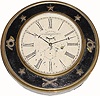 C.1868, A. D. Smith, (Cincinnati, Ohio), Marine movement gallery clockin very good original condition.
 -
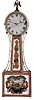 New Hampshire, 8 day, weight driven, brass movement Patent or banjo timepiece. The signature on the dial is difficult to read, but it appears to read in part Smith & Willis. There was a Smith & Williston in Keene, New Hampshire who advertised as clockmakers, that may be the firm name.
 -
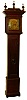 Gabriel Smith, Barthomley, England, 30 hours, time, calendar and bell strike, single weight driven movement with anchor escapement in dark English oak case with 4" glass porthole in trunk door. The square brass dial has a single hand, calendar aperture at 6 signed silvered chapter ring, c1720
 -
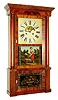 Philip L. Smith, Marcellus, Onondaga County, N.Y., Empire mantel clock, 8 days, time and strike, weight driven Swiss cheese movement in a mahogany veneer case with painted wooden dial and reverse painted tablets, c1830
 -
![J. Smith and Sons Clerkenwell, [attributed] skeleton clock, cathedral form plates with delicate piercing and decorative turned baluster form pillars, on ball feet and with stepped base, engraved Roman numeral silvered dial with pie crust edge, blued steel hands, brass pendulum with decorative star form steel ornament at center, 8 days, single fusee movement with recoil escapement and passing strike, all mounted to a velvet lined ebonized wooden base with glass dome, c1850](/images/robertoschmitt27/t7409_a.jpg) J. Smith and Sons Clerkenwell, [attributed] skeleton clock, cathedral form plates with delicate piercing and decorative turned baluster form pillars, on ball feet and with stepped base, engraved Roman numeral silvered dial with pie crust edge, blued steel hands, brass pendulum with decorative star form steel ornament at center, 8 days, single fusee movement with recoil escapement and passing strike, all mounted to a velvet lined ebonized wooden base with glass dome, c1850
J. Smith and Sons Clerkenwell, [attributed] skeleton clock, cathedral form plates with delicate piercing and decorative turned baluster form pillars, on ball feet and with stepped base, engraved Roman numeral silvered dial with pie crust edge, blued steel hands, brass pendulum with decorative star form steel ornament at center, 8 days, single fusee movement with recoil escapement and passing strike, all mounted to a velvet lined ebonized wooden base with glass dome, c1850 -
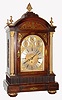 English, John Smith and Son, 85 Strand, London, large 3-fusee, 8-bell, 2-tune, quarter chiming bracket clock, the rosewood veneer case with brass inlay, the door flanked by gilt and reeded brass columns, the side frets of cast brass in the Georgian style, and the arched dial with applied brass spandrels and with 3 subsidiary dials for F/S, Chime/Silent, and 8-bell or Westminster tune. Overall very good original condition, c1890
 -
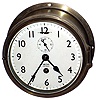 Smiths, Great Britain, "Astral" 8 day brass marine time piece, c1935