Search Antique Clocks
Showing 441–460
of 6,176 clocks
by K
-
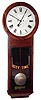 Atkins Clock Co., Bristol, Conn., "30 Day Extra", 30 day, time only, two weight driven movement in rosewood case with painted metal dial, c1870
 -
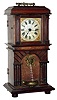 Hamburg American Clock Co., Germany, water fountain 30 hour walnut novelty mantel clock, c1900
 -
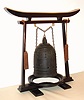 A rare and early Japanese bell clock (Tsurigane Dokei) within a finely cast bronze bell with Japanese characters and double headed dragon form handle; having a posted, iron, double spring driven, striking movement with crown wheel escapement and time regulated by a large circular balance with moveable double weights, originally for adjusting the temporal hours every day before each sunrise and sunset with the change of each Japanese season. The brass dial with single, fixed hand has traditional Japanese numerals 9 through 4 with applied silvered butterflies to the original surrounding dial plate. The rotating dial with adjustable "hour" and "half hour" markers is a common 19th Century upgrade to many very early Japanese clocks that have a single foliot or balance, since changing the weights and hence the rate before sunrise and sunset each day was extremely unhandy. This is verified by J. Drummond Robertson in The Evolution of Clockwork , page 226 saying "we find some of the old clocks "converted" to the new style of motion work. The old fixed hour circle with its revolving centre was removed and the new revolving circle and its fixed hand with adjustable "hour" plates was substituted." This is the case in each of the only other examples of Japanese Bell Clocks of which we are aware: see Japanese Clocks by N.H.N. Mody, plate 113, fig.1 for an almost identical example to the clock being offered. This dial conversion is also apparent in the Bronze Bell Clock sold at Sotheby's Masterpieces From the Time Museum Sale, Part Two, 19 June 2002, lot 126. An inscription on the bell reads Fukushima ya Katsutaro 1689, who may be the maker of either the clock or the bell. Most Japanese spring driven clocks have a fusee to the time train and a going barrel to the strike train. This movement is anomalous, in that is has two going barrels. It may be that the Japanese had not developed a method of turning a fusee at this early date, C.1690
 -
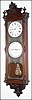 Ithaca Calendar Clock Co., Ithaca, New York, "Regulator No. 1". 8 day, time and perpetual calendar, center sweep seconds, two weight driven movement in a walnut case with engraved and highlighted dial mask and papered metal dials, s#20, dated December of 1891
 -
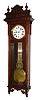 Waterbury Clock Co., Waterbury, Conn., "Regulator No. 60" wall clock, 8 day, time only, weight driven movement with deadbeat anchor escapement, sweep seconds and gridiron pendulum in an oak case with white enamel dial signed at bottom "MANUFACTURED BY WATERBURY CLOCK CO. U.S.A." and Waterbury G-clef hands, c1903
 -
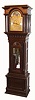 Walter H. Durfee, Providence, Rhode Island, for Bailey, Banks and Biddle, Philadelphia, Penn. on dial, 9 tube hall clock, 8 day, time, strike and 1/4 chime three weight driven movement playing Westminster or Whittington tune on tubes signed by Walter Durfee with patent date 1887 and with single jar mercury pendulum. The silvered brass dial has moon phase with elk scene, strike / silent and tune selector discs. The case is oak with a dark walnut finish and has carved cornice moldings, 11 raised panels, barley twist columns, of which four are flanking the trunk and two are flanking hood, sunburst carving above trunk door and beveled glass in hood and trunk doors. There are exceptional lion's head escutcheons on both hood and trunk doors, c1895
 -
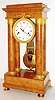 Brocot, France, large portico clock with pinwheel escapement, round time and strike movement with large barrels, possibly of two week duration, count wheel striking on a bell, crutch with fine beat adjustment, white enamel dial signed "Brocot", gilt Breguet style hands, with sweep seconds, heavy gilt brass and steel gridiron pendulum with knife edge suspension beating half seconds, the case veneered in figured ash, with gilt bezel, column mounts, and feet, with gilt beat scale, c1830
 -
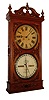 Ithaca Calendar Clock Co., Ithaca, NY, "Regulator No. 1 or Hanging Bank", 8 day, time and perpetual calendar, two weight driven movement in a walnut case with applied crushed shell moldings and papered metal dials, dated 1870
 -
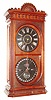 Ithaca Calendar Clock Co., Ithaca, NY, "No. 13 Shelf Kildare", 8 day, time and strike calendar shelf clock, c1880
 -
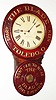 Baird Clock Co., Plattsburgh, NY, "The Blade, Toledo, Ohio" advertising wall clock, 8 day, time only, spring driven movement in wooden case with paper mache doors and paper dial, c1893
 -
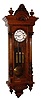 Wilhelm Kunz, Wien, Austria "Vienna Regulator in Altdeutsch Style" wall clock, 8 day, time and Grande Sonnerie strike, three weight driven movement in a walnut case flanked by fluted fully turned columns with elaborately carved capitals and bases and two part white enamel dial, c1880
 -
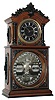 Ithaca Calendar Clock Co., Ithaca, NY, "No. 3 1/2 Parlor", 8 day, time and strike calendar clock, c1881
 -
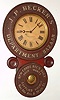 Baird Clock Co., Plattsburgh, NY, "J.P. Becker's Department Bazaar" miniature advertising wall clock, 8 day, time only, spring driven movement in wooden case with paper mache doors and paper dial, c1893
 -
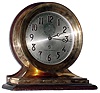 Chelsea Clock Co., Boston, Mass., private label for Tilden-Thurber Co., "Commander" time only 8 day brass and mahogany mantel clock, 8.5" dial, 1905
 -
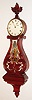 Nelson H. Brown, Boston, Mass., "Lyre Banjo" wall clock, 8 day, time only, weight driven movement apparently by Chelsea Clock Co. in a mahogany case with reverse painted tablet and painted metal dial, c1920
 -
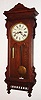 Waterbury Clock Co., Waterbury, Conn., "Regulator No. 57", 8 day, double weight oak case wall timepiece, c1906
 -
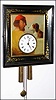 Balz Kleiser in Schwaerzenbach, Germany, Black Forest, double moving eye wall clock, 30 hour, time and strike, weight driven wood and brass movement in a gold leafed and painted picture frame case surrounding an oil on board painting of a gentleman and his dog gazing at one another with white enamel dial, c1875
 -
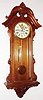 Wm. L. Gilbert Clock Co., Winsted, Conn., "Regulator No. 5" wall clock, 8 day, time only, weight driven movement in a walnut case with private label paper dial for "S.G. BEERS JEWELER", c1885
 -
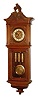 Gustav Becker, Freiburg, Germany, "Vienna Regulator in Baroque Style" wall clock, 8 day, time and Grande Sonnerie strike, three embossed weight driven movement with embossed pendulum bob in a walnut case with carved top and other applied carvings. The multicolor and white enamel dial is inset with embossed brass center, c1880
 -
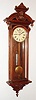 Wm. L. Gilbert Clock Co., Winsted, Conn., "Regulator No. 4", 8 day, time only, weight driven movement in a walnut case with rosewood backboard and a paper dial, c1881