Search Antique Clocks
Showing 241–260
of 5,197 clocks
from France
-
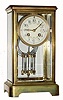 C.1910, French, Marti and Cie. 4-glass crystal with fancy dial bearing floral garlands.
 -
 C.1890 Vincenti and Cie, 8-day time/strike French gilt spelter and marble figural mantel clock, a young lady at harvest time.
 -
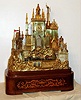 French, Napoleon III, ormolu musical and automaton novelty mantel clock, in the form of a castle, time and bell strike with silk thread suspension, c.1870, less dome, two "trains" with early style locomotives and cars traveling across the front on two bands, driven by an independent spring barrel, the plinth also housing a musical movement
 -
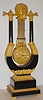 French, lyre form mantel clock, ebonized wood case with ormolu mountings, the pinwheel movement contained within the base of the gird iron pendulum, which has knife edge suspension, the entire movement and pendulum swinging as a single unit. Gilt engine turned dial with painted roman numerals and seconds hand, C. 1840
 -
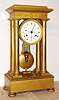 French, Chaveau, Paris, 4-Column Empire mantel clock, bright ormolu case, the well made pinwheel movement with 60 pins in 'scape wheel and affording half seconds on the dial, also with central calendar and knife edge suspension, C.1830.
 -
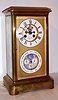 French, 8-day time/strike brass and glass double dial crystal regulator calendar clock retailed by Fr. Baumann, Wien., the calendar dial is perpetual, correcting for short months, and with phases of the moon. Dials are offset by a stippled and gilt brass mask, C.1900
 -
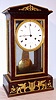 French, "LeRoy, Horologer de Madame, Paris", 8-day time/strike silk thread suspension clock, in an architectural mahogany case with bright ormolu mounts, C. 1810
 -
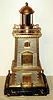 French, Lighthouse Clock with helical Torsion Pendulum, in a rectangular case simulating stone construction silvered center stones and brass-gilt corner stones. The square movement is signed with Guilmet trademark, serial No. 1023. The briskly rotating pendulum, suspended from the center of the dome, is surmounted by clear and colored prisms that simulate the motion of a lighthouse beacon. c.1885
 -
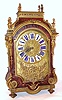 Barthe Dijon, French Louis XIV Boulle type mantel clock with 8 day time and bell strike movement with crown wheel escapement. The tortoise shell veneer case is flanked by four caryatids and is profusely inlaid with brass and some silver highlights. The engraved and embossed brass dial has large enamel cartouche numerals, c1700
 -
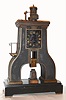 French, Guilmet, (mov't by Japy Freres), STEAM HAMMER clock from the French Industrial series designed by Guilmet, 8-day time/strike, the vertical impact "hammer "serving as the pendulum after power has been transferred 9 times, "as found" c1880
 -
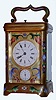 French, Brass Champleve enamel case time, strike on gong, alarm with repeat carriage clock retailed by Robbins, Clarke and ?, Philadelphia, C.1900
 -
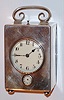 French, Grand Sonnerie with alarm/repeat carriage clock in an English silver case. A lever on the bottom of the case allows one to change from Grand Sonnerie to Silence to Petit Sonnerie, C.1900
 -
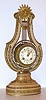 French lyre form mantel clock made for Tiffany and Co. New York (signed on movement and dial) with 8 day time and bell strike, spring driven movement in creamy onyx and ormolu case, c1890
 -
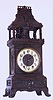 French, Marti and Cie, 8-day time/strike automaton of two figures striking a bell in the tower. The heavy case appears to be white metal with a dark finish applied. The bell ringers do not actually strike the bell as the movement strikes a wire gong to indicate the hours (it is a deep tone gong that sounds similar to a large bell), C. 1900
 -
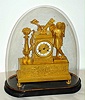 French Empire, ormolu figural mantel clock 8 day time and strike mvt with silk thread suspension on a wooden base with period glass dome, c1830
 -
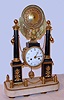 Roque, Paris, French architectural mantel clock with 8 day time and strike on bell spring driven movement engraved with the maker's name and No. 1282. The clock rests on white marble base supporting six posts linked by chain with two marble pillars with ormolu appliques and finials centered by brass spread wing eagle perched above movement supporting ornately floral embossed medallion. The porcelain dial has intricately pierced brass hands and is signed Roque Paris (fired in), c1820
 -
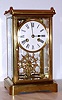 French crystal regulator mantel clock 8 day time and strike movement with ship's wheel as detached balance and Roman numeral porcelain dial, c1890
 -
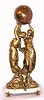 French figural mantel clock with spelter statues of two maidens supporting globe with 8 day time and strike on bell, spring driven movement with platform lever escapement with one putti between them holding an hour glass, c1900
 -
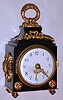 French, "Pendule d'officier", 8-day dore bronze travel timepiece. These timepieces are copies of the type made in the 18th and early 19th century fitted with a platform escapement like those used in a carriage clock, c1900
 -
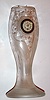 French, Lalique Art Nouveau glass vase engraved on the bottom "Le Rosey", Paris, fitted with a small front key wind watch movement.