Search Antique Clocks
Showing 121–140
of 1,580 clocks
from England
-
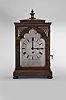 Thomas Cox Lavory, 47 Cornhill, London, mantel timepiece, 8 day, time only with pull alarm, spring driven fusee movement in a rosewood veneered case of Gothic design with stepped molded base and top, applied wood ornaments on the door front with foil arch window, silvered dial engraved as above, Roman numeral dial, and blued steel moon hands.
 -
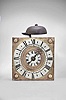 England, a small, 18th century 30 hour hanging alarm timepiece, square brass dial plate decorated with hemispheres at the corners, silvered roman numeral chapter ring and alarm disc, single blued steel hand, iron square posted movement with recoil escapement and seconds pendulum, the back with loop and spikes for hanging, and lead weights
 -
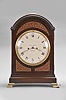 Thomas Harper, London, an 18th century mahogany bracket clock, the case with molded arch top and base, and on brass bracket feet, the case front with three textile backed brass frets, the upper crescent shaped, and the two lower frets conforming to the shape of the dial and case, the sides also with pierced frets, Roman numeral white painted dial with Arabic minutes, finely finished brass hands, two train fusee movement with verge escapement, the back plate with symmetrical foliate engraving and basket of flowers, the upper right corner stamped "2978", counting the hours on a bell, and repeating the last hour on demand
 -
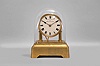 Eureka Clock Co., London, battery powered mantel clock with oversized balance wheel movement on a brass base and a cream color porcelain dial, s#2550
 -
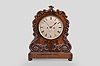 Connell, Late Ganthony, 83 Cheapside, London, a large, mid 19th century mahogany bracket clock, rectangular molded base with compressed ball feet, the case front with applied carved foliate ornaments with scrolls terminating in pendant husks, and with carved C and S scrolls flanking and above the silvered roman numeral dial, the case sides conforming to the contours of the carved elements, back with fabric lined door and fine mahogany fret, blued steel pierced spade hands, two train fusee movement with recoil escapement, counting the hours on a bell
 -
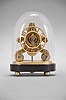 John Pace, Bury, St. Edmunds, a rare miniature skeleton timepiece, the brass scroll frames and brass base with beveled edges, the back plate measuring just 5 1/4" in height, 8 day fusee movement with thread suspension and recoil escapement and light wheels with five spoke crossings, skeletonized, Arabic numeral dial with knurled inner and outer rings, blued steel Breguet style hands, all resting on an ebonized oval base with brass ball feet and conforming dome. Brass base signed "John Pace Bury St. Edmunds 229 "
 -
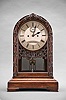 John L. Fenn, a Victorian mahogany table regulator, the arch top case with squat ogee bracket feet and molded base, the door with half round molding with carved leaves and vine, seemingly wrapped around the molding, Roman numeral silvered dial with seconds below 12:00, blued steel hands, and with pierced floral and C scroll carving below, large 8 day fusee movement striking the hours on a coil gong, faux mercury pendulum with heavy brass cylinder fixed horizontally below the jar
 -
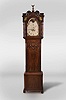 Charles Monks, Prescot, Lancashire, England, tall clock, 8 day, time and strike, weight driven movement in a Gothic revival mahogany case with reverse painted glass inserts above hood door, Gothic shaped trunk door over a base with framed panel on straight bracket feet. The painted metal dial has moon phase, seconds bit and calendar.
 -
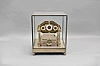 Emperor Clock Co. Ltd., London, a reproduction Congreve rolling ball timepiece, fusee movement with separate dials for minutes, hours and seconds, the plates supported by four turned columns, all resting on ball feet, the tray with zig zag path for the steel ball "oscillator" suspended below the movement, with rectangular base, and conforming glass dome, serial #053 from an edition of 250.
 -
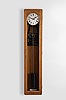 The Synchronome Co., Ltd., England, master clock, oak case, Roman numeral silvered dial, electromechanical movement providing impulse every thirty seconds from a falling gravity arm to pendulum and cylindrical bob, NRA #3439
 -
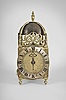 Probably London, England, an early 18th century striking lantern clock, the brass case with turned, tapered columns at the corners, with ball feet and slender urn finials, the top with arcaded brass gallery fixed to the top plate, front and sides with cast frets, the top with brass bell strap with finial and large bell, dial center with engraved foliage and tulips, the individual corners with a single, decorative button, silvered brass chapter ring with roman numerals and single steel hand, movement with recoil escapement, seconds pendulum, and count wheel striking, the case bottom with crude, cryptic engraving, and possibly dated 1717
 -
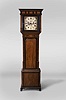 Thomas Gaskell, Knutsford, County Cheshire, England, tall clock, 8 day, time and strike, weight driven movement in a flat top heavily inlaid mahogany case with cross hatching and conch shell decorations. The painted metal square dial has seconds bit and calendar.
 -
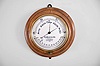 W. H. McCarthy and Son, London, large aneroid barometer and thermometer.
 -
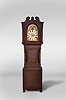 Hardy and Marsh, 51 New St, Birmingham, England, 8 day, time and bell strike, weight driven movement tall clock in mahogany case with rope turned full columns flanking hood and trunk door. The painted metal dial has moon phase, seconds bit and calendar.
 -
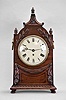 England, a 19th century mahogany bracket clock with passing strike, the case on turned wooden feet, the base with quarter round, and bead and reel moldings below a carved festoon, the upper part of the case with two carved laurel fronds, turned, carved finials, and pagoda top with carved, partial C scrolls and bellflower, the sides with pierced brass, lancet arch frets, and stamped, ring handles with floral mounts, roman numeral white painted dial with blued steel Breguet style hands, 8 day fusee timepiece with shouldered plates, recoil escapement, and passing strike at the hour, brass pendulum with brass clad bob
 -
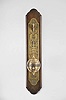 Thwaites & Reed Ltd., England for The Franklin Mint, "Sir Francis Drake Falling Ball Clock", 8 day, time only, weight driven movement with annular time display in an engraved spherical case suspended from a cast brass bracket mounted to a wood back board with engraved brass plaque.
 -
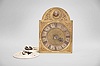 England, a mid 18th century, 30 hour posted frame clock with bracket, arched brass composite dial with matted center, roman numeral silvered chapter ring, single cut steel hand, iron movement with rectangular posts, seconds pendulum, and count wheel striking, brass clad weight, and 20th century bracket.
 -
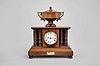 Automatic Memorandum Clock Co., London, "Davidson's Patent Automatic Memorandum Clock", 8 day time and reminder, spring driven balance wheel movement in a walnut case with four full pillars and wooden urn on top, white enamel dial and blued steel hands.
 -
 S. Shaw, Lancashire, United Kingdom, "Mackenzie's Ink Polygraph", clockwork motor for the feed of paper tape and time interval marking, diaphragm receivers with and without leather straps, two ink pens, and other accessories, all in a fitted velvet-lined case with an ink polygraph recording on a paper roll dated 1918.
 -
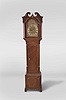 English Tall Clock DIal and Case Only- inlaid mahogany case on straight bracket feet with unsigned brass dial now fitted with quartz movement