Search Antique Clocks
Showing 81–100
of 1,580 clocks
from England
-
 Robert Gibson, Whitehaven, England tall case clock, 8 day, time and strike, weight driven movement in an inlaid mahogany case with rope turned columns flanking trunk and hood. The painted iron dial has moon phase and second's bit, c1820
 -
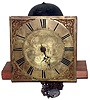 Movement and dial, Timothy Tregoe, Great Marlow, English brass 30 hour time and strike weight driven, square dial, one hand, c1770
 -
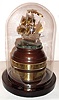 The Boehm "Mayflower Clock", Llandow, Wales, modern annular commemorative 8 day timepiece by K.J. Bradford, Chelmsford, England, Serial No. 251, late 20th century
 -
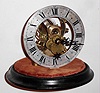 Eureka Clock Co., London, movement now associated with wood base and glass dome, c1906
 -
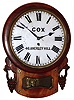 Cox, 46 Anerley Hill, England short drop wall time piece, 8 day, time only, spring driven movement in mahogany veneer case with side carvings and brass line inlay, c1860
 -
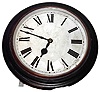 English round dial clock, 8 day, time only, spring driven fusee movement, winds and sets from rear of case, in cast iron case with 18" painted metal dial, c1875
 -
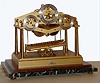 Dent, London, England, "Congreve Rolling Ball Clock", 8 day, spring driven, fusee movement with maintaining power is regulated by a rolling steel ball traversing an inclined plane every 15 seconds, tripping a lever, tilting the plane in the opposite direction, while registering 15 second intervals on the right dial, minutes on the center and hours on the left all on a marble base in a Plexiglass case, dated 1973
 -
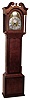 Thomas Wagstaffe, London, 8 day time and strike with calendar composite brass 12" dial tall clock. Wagstaffe was a Quaker who frequently supplied movements to his fellow American Quakers who had them cased in Philadelphia or Newport, movement c1770, case probably c1810.
 -
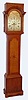 Henry Joseph, Camborne, English tall case clock with 8 day, time and bell strike, weight driven movement in oak case with brass dial decorated with eagle grasping banner reading "TEMPUS FUGIT", c1830
 -
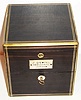 England, chronometer no. 4653 by J. Sewill, London, two day fusee movement with spring detent escapement, chronometer balance with helical hairspring, spotted plates, silvered Roman numeral dial with Arabic five minute markers, up/ down indicator, dial signed J. Sewill, 30 Cornhill, Royal Exchange, London, Maker to the Admiralty, also marked with mention of awards received in London 1862 and Paris 1867, blued steel seconds hand, gold hour and minute hands, lacquered brass bowl in gimbals with locking lever, ratchet type key correct and possibly original, beautiful ebony box with brass binding and hardware, mother of pearl plate on front of box marked J. Sewill 30 Cornhill London c1870
 -
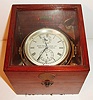 Henry Browne and Sons Ltd., Barking, London, marine chronometer in mahogany box, the 2 day movement with spring detent escapement, cut bimetallic balance with cylindrical weights for temperature compensation, white helical balance spring, spotted gilt plates with blued steel screws, silvered Roman numeral dial with wind indicator and number 16926, blued steel hands, brass bezel with beveled glass, lacquered brass bowl and hardware, mahogany box with glazed top, brass tag showing chronometer number, with key c1910
 -
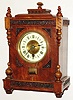 Automatic Memorandum Clock Company, Ltd., London, 8 day walnut reminder clock, c1905
 -
![Princeps "Master Clock" Electrical New System made by the Telephone Mfg. Co. Ltd., London, England, time only, electrically driven [low voltage DC] movement with invar pendulum mounted from a bronzed bracket and connected to an impulse mechanism in a cherry and/or mahogany case with silvered brass round 5" dial, c1930 including slave clock](/images/robertoschmitt25/t6398_a.jpg) Princeps "Master Clock" Electrical New System made by the Telephone Mfg. Co. Ltd., London, England, time only, electrically driven [low voltage DC] movement with invar pendulum mounted from a bronzed bracket and connected to an impulse mechanism in a cherry and/or mahogany case with silvered brass round 5" dial, c1930 including slave clock
Princeps "Master Clock" Electrical New System made by the Telephone Mfg. Co. Ltd., London, England, time only, electrically driven [low voltage DC] movement with invar pendulum mounted from a bronzed bracket and connected to an impulse mechanism in a cherry and/or mahogany case with silvered brass round 5" dial, c1930 including slave clock -
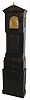 English, triple fusee movement, quarter chiming on choice of 8-bells or 5 tubular bells, now in a well constructed case of the same period, with hand carved decorations, purpose made to fit in a room corner of a home near Bath, all parts, c1910, the dial signed W. W. Kemp and Co., Bristol.
 -
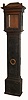 Tall clock case only, English made of pine with bell top hood inset with round glass in trunk door with spear point strap hinges, c1740
 -
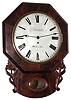 Zahringer, Birmingham, mahogany 8 day single fusee English wall clock, c1860
 -
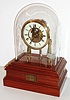 Eureka Clock Co., Ltd, London, England, the "1000 day" battery powered movement with large bimetallic balance and spotted brass plates, supported by two turned baluster form columns, with white enamel Roman numeral dial, blued steel spade hands, brass bezel with convex beveled glass, all covered with a glass dome, and mounted to a beautifully made, polished mahogany base with battery compartment, the front with a brass plaque engraved "Eureka 1000 Day Motion" c1910
 -
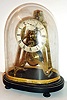 English fusee skeleton clock with platform escapement, polished A frame plates with 4 bold baluster form pillars, vertically mounted silvered platform with duplex escapement marked "Philcox 277 Patent", the brass balance with blued steel spring, silvered Roman numeral dial with seconds at 12:00, blued steel hands, mounted on a black painted velvet covered base, and covered by a conforming glass dome, c1850
 -
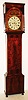 McLachlan, Glasgow, Scotland, tall clock, 8 day, time and bell strike, weight driven movement in a mahogany case with flat top hood and painted iron dial with portraits of women from the different domains of Great Britain surmounted by Queen Victoria in the arch, c1850
 -
 Dial signed: Joseph Fordham, Braintree, England tall clock, 30 hour, time and bell strike, one weight driven movement with endless rope winding, now in a Bombay style highly figured crotch walnut veneer case with heavy walnut banding around trunk exterior and base. The one handed brass dial signed "Jos. Fordham Braintree" has applied brass corner spandrels and English crown and cherub spandrel in arch, c1730