Search Antique Clocks
Showing 621–640
of 1,580 clocks
from England
-
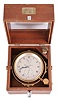 Thomas Mercer, St. Albans, two day marine chronometer, 13 jewel fusee movement with spotted plates, Earnshaw's escapement, and freesprung cut bimetallic balance with helical balance spring, Roman numeral silvered dial with wind indicator and blued steel spade and poker hands, with gimballed brass bowl, contained in a two tier mahogany box, serial #25964
 -
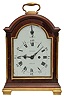 Samuel Toulmin, Strand, London, a Georgian mahogany bracket clock with enameled dial, the break arch case with polished brass furniture, and glazed sides, the case top and base molded on four sides, unusual white has Roman numerals, Arabic five minute markers, and strike/silent indicator in the arch, pierced, blued steel hands, two train fusee movement with verge escapement, the back plate engraved with acanthus, flowers, and C scrolls, and striking the hours on a bell.
 -
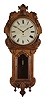 English, 8 day, time spring brass chain drive fusee movement tavern clock. Dial is signed McHerman, Manchester.
 -
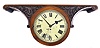 England, double-sided gallery clock, 8 day, time only, spring-driven fusee movement in a carved walnut case with 11 inch painted metal dials on opposite sides, both with cream background and black Roman numerals, blued steel Paris style spade hands.
 -
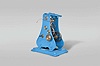 England, tower or street clock, time only, weight driven movement with anchor escapement signed on both blue painted cast iron plates W.H. BAILEY & CO LTD, MANCHESTER
 -
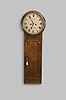 D. Shaw, Lancaster, England, tavern wall clock, 8 day, time and strike, weight driven movement in an oak case with painted metal dial
 -
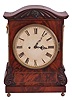 England, unsigned, 8 day, time and strike, spring fusee movement mahogany bracket with brass inlay, side grills, feet and side handles, c1890.
 -
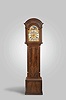 T. Clare, Hatton, England, tall clock, 8 day, time, strike and chime on a nest of six bells, weight driven movement in a inlaid mahogany case with four fluted columns flanking hood. The trunk has a shaped crotch mahogany door flanked by fluted quarter columns with gold painted capitals over a crotch mahogany base framed by string inlay and contrasting mahogany veneer. The brass dial has silvered chapter ring, moon phase, maker's signature, silvered second's bit and calendar aperture.
 -
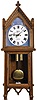 Louis Hoeber, 31 Duke St, Grosvenor Square, London, England, monumental Gothic revival wall clock, 8 day, time and strike, weight driven movement in an oak case with fleur-de-lis pediment top, and egg and dart molding flanked by pinwheel carved side elements over glazed door exposing large brass pendulum bob and beat scale. The reverse painted glass Gothic roman numeral dial with gilt lattice surround on a blue ground has maker's signature, address and Gothic hands
 -
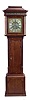 Thomas Moss, Frodsham, England, tall clock, 8 day, time and strike, weight driven movement in an oak case with mahogany banding, bell top, four full reeded Corinthian columns on the hood with painted foliate frieze above dial, reeded quarter columns flanking trunk door. The brass dial has brass corner spandrels, silvered chapter ring and silvered center boss with maker's signature and seconds bit and surrounded by brass calendar ring indicated by hand off of center arbor.
 -
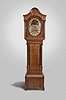 Thomas Moore, Ipswich, England, tall clock, 8 day, time and strike, weight driven movement with celestial display and signs of the Zodiac on the brass dial with silvered chapter ring, signed by the maker and in a mahogany veneer case with ebonized inlay with pagoda type top and full Corinthian columns surmounted by brass capitals on both hood and trunk
 -
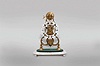 England, single train skeleton clock with passing strike, the brass frames with gothic style fretting, roman numeral, skeletonized, white painted dial, blued steel spade and poker hands, 4 wheel fusee movement with four spoke crossings, and striking a single blow at the hour on a bell, mounted to an oblong, green velvet lined, white marble base
 -
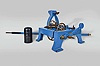 Midland Clockworks, J. Smith & Sons, Derby, England tower or street clock, time only, weight driven movement with pinwheel escapement in blue painted cast iron frame
 -
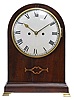 Rivers, Cornhill, London, 8 day, time and strike, spring driven brass fusee movement mahogany bracket clock.
 -
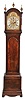 Fra. Robinson, In the Temple, England, tall clock, 8 day, time and strike, weight driven movement in a mahogany case with three brass finials, reeded corners with brass inserts and fretted sides flanking the hood, crotch mahogany trunk door and lower panel resting on applied bracket feet. The brass dial has maker's signature, cast brass corner spandrels and silvered chapter ring, calendar indicator, subsidiary seconds and pendulum rate adjustment.
 -
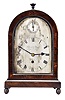 Ellicott and Smith, 17 Royal Exchange, London, a regency rosewood bracket timepiece, round top case with turned finial on a molded base with turned feet, sides with glazed, fish scale fret, signed Roman numeral silvered dial with blued steel hands and pointer for regulation, single train fusee movement with recoil escapement and rise and fall regulator, the back plate signed and with wheatear engraved border
 -
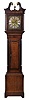 Joseph Baker, Appleby, (County Westmorland), England, tall clock, 8 day, time and strike, weight driven movement in a mahogany and oak veneer case with a dental molded broken arch pediment, brass rosettes and center finial, two fluted columns with brass capitals flanking hood over an inlaid oak and mahogany trunk, fluted columns flanking trunk door resting on straight bracket feet. The brass dial has a silvered chapter ring, date aperture and cast corner spandrels.
 -
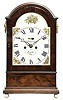 English, J. Paterson, Leith, England, 8 day, time and strike brass fusee movement bracket clock.
 -
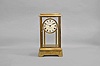 Eureka Clock Co., Ltd., London, type 1, 1000 day electric clock in a polished brass, four glass case, the batteries concealed in the base, signed Roman numeral white enamel dial, blued steel spade hands, and movement with spotted plates and large bimetallic balance, serial #2777
 -
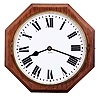 England, double-sided postal clock, 8 day, time only, spring driven fusee movement in an octagonal mahogany case with ogee molded edge, two 12 inch painted white metal dials under glass on opposite sides, both with Roman numerals and the letters "G.P.O." (General Post Office) below the center arbor, spade steel hands.